
No. An enlarged prostate and cancer can exist at the same time, which is why PSA is measured when the result could change the decision.[1]
UROLOGY · CASABLANCA
Enlarged prostate: symptoms and treatment
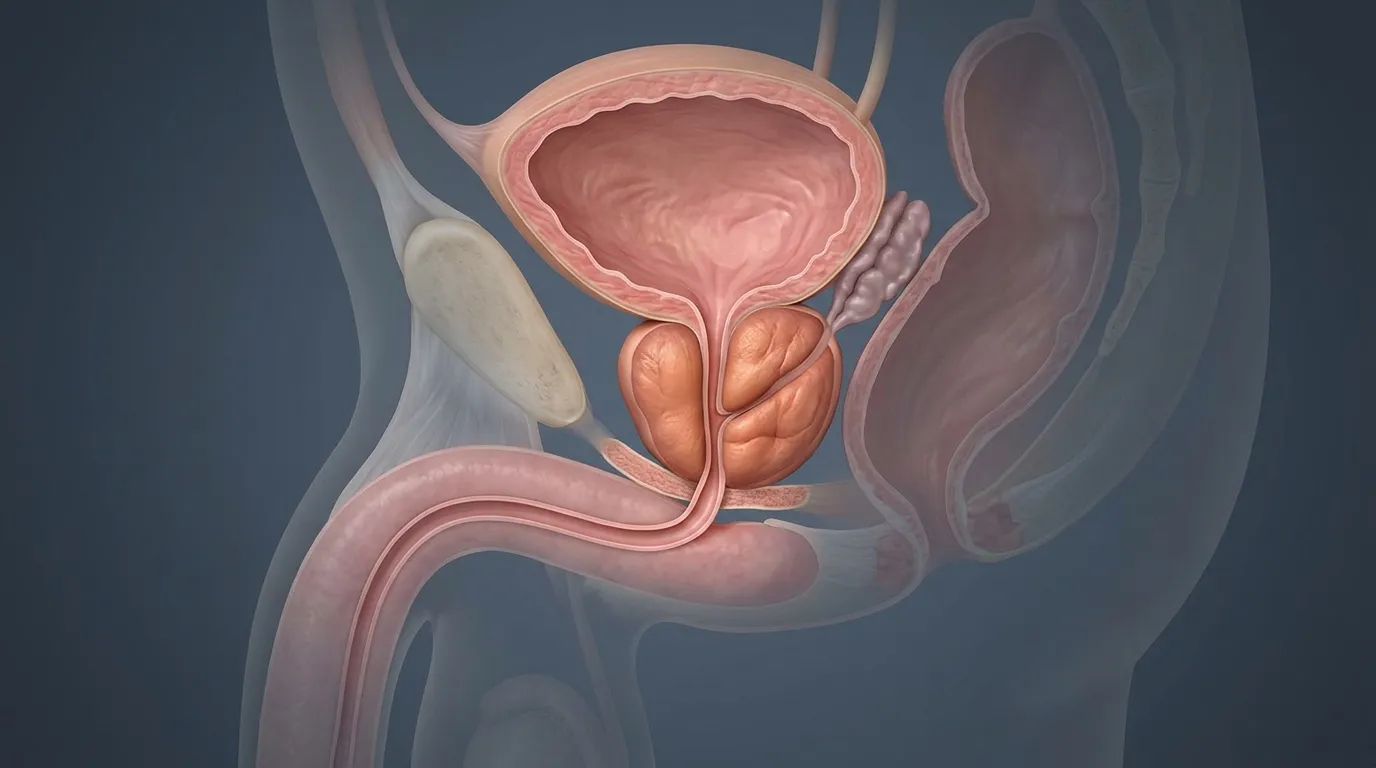
A weak stream, getting up at night, sudden urges to pass urine: after 50, these problems often come from an enlarged prostate (benign prostatic hyperplasia, BPH), a growth of the prostate that is not cancer. Treatment follows how much it bothers you: monitoring if the trouble is mild, medicines if it weighs on your daily life, an operation when medicines are no longer enough or if there is a complication.
01 · KEY POINTS
In short
An enlarged prostate is a benign increase in the size of the gland. It can narrow the flow of urine, but it is not cancer and does not turn into cancer. Care depends mainly on how much it bothers you, its effects on the bladder and kidneys, its measured volume, and your preferences.
In one study, about 85 in 100 men with mild symptoms were stable after a year.[1]
An alpha-blocker may start working within hours to days, but its full effect takes a few weeks.[1]
Repeated urinary blockage, infections or bladder stones, persistent blood in the urine, affected kidneys, or medicines that are not enough.[1]
Measured by ultrasound in millilitres (mL), it helps guide the operation. How much symptoms bother you matters too.[1]
Appointments: +212 5 22 77 40 48 · Centre d'Urologie Casablanca, Maârif.
02 · UNDERSTANDING SYMPTOMS
Prostate size does not tell you how much it bothers you
The prostate narrows the passage urine flows through. This causes two groups of symptoms. A small prostate can cause a lot of trouble, and a large one very little. Treatment is therefore decided according to how much it bothers you and its effects on the bladder and kidneys, not size alone.
Emptying symptoms
- a weak or stop-start stream
- waiting before urine starts
- having to push
- feeling that the bladder has not emptied
- dribbling after you finish.
Urgency and frequency
- needing to pass urine often
- getting up at night
- sudden urges that are hard to hold.
03 · ASSESSMENT
What tests are done at the first consultation?
The doctor asks about your symptoms and examines you, sometimes with a rectal examination: a gloved finger in the rectum to feel the prostate. A urine test is usually requested. European guidelines also suggest keeping a voiding diary: for a few days, write down the time and amount each time you pass urine. [1]
Depending on your case, we may measure:
Urine flow
You pass urine into a device that measures the strength of the stream.
Urine left in the bladder
An ultrasound measures the amount left after you pass urine.
Prostate volume
Measured by ultrasound, it helps guide the choice of operation.
PSA
A blood test, when the result could change the decision. See our PSA test information.
04 · FIRST STEPS
Advice and medicines
The advice that most often changes your nights: drink less at the times when urges bother you, especially in the evening. European guidelines also advise cutting down on coffee and alcohol, which can make you pass more urine and irritate the bladder. [1]
When symptoms persist, several groups of medicines exist. The scientific names are in brackets so you can recognise them on a prescription.
Alpha-blockers
Relax the bladder outlet and prostate. The stream often improves within hours to days.[1]
Finasteride or dutasteride
Reduce prostate volume by about 18 to 28% over two to four years.[1]
Combination treatment
Combines the effects of an alpha-blocker and a medicine that reduces prostate volume.[1]
Tadalafil
A medicine also used for erection problems. It can improve urinary symptoms.[1]
Antimuscarinics and beta-3 agonists
Reduce sudden urges to pass urine.[1]
Plant extracts
Saw palmetto and hexane extract have a modest effect on symptoms.[1]
Products sold as a “miracle cure” do not appear in the guidelines.
05 · MAKING A DECISION
When is an operation needed?
An operation is offered in two situations: [1]
When urine flow or kidney health is at risk
- repeated complete blockage of urine (retention)
- repeated urinary infections
- bladder stones
- persistent blood in the urine
- swollen kidneys or reduced kidney function.
When symptoms remain troublesome
- medicines do not relieve symptoms enough
- or their side effects bother you too much.
06 · OPTIONS BY PROSTATE SIZE
Which operation for which prostate?
The choice first depends on prostate volume, measured by ultrasound in millilitres (1 mL of prostate weighs about 1 gram). It also depends on whether there is a middle lobe, which bulges into the bladder, and on blood-thinning treatment.
01Under 30 mLNo middle lobe
OPTION TO DISCUSS
Transurethral incision (TUIP)
Two small cuts open the passage without removing tissue. Trials report repeat surgery in about 18 men in 100, against 7 in 100 after TURP.[1]
Procedure notes0230 to 80 mLMid-sized prostate
OPTION TO DISCUSS
TURP or laser enucleation
TURP removes the enlarged tissue in small pieces. Laser enucleation detaches it from the outer shell before it is cut inside the bladder. Either option may be offered, depending on your situation.[1]
Laser surgery (ThuLEP)03Over 80 mLLarge prostate
OPTION TO DISCUSS
Laser enucleation
The surgeon removes the obstructing tissue through the urethra, without an abdominal scar. ThuLEP is one option for larger prostates.[1]
Laser surgery (ThuLEP)04Blood-thinning treatmentIf it cannot be stopped
SPECIAL CIRCUMSTANCE
Laser surgery may be considered
European guidelines give priority to laser vaporisation and also list laser enucleation, including Thulium, with a weak recommendation. The decision is made with your urologist and the doctor who prescribed the anticoagulant or antiplatelet medicine. [1]
These operations go through the urethra (the tube you pass urine through), with no scar on the abdomen.
07 · DISCUSS BEFORE SURGERY
Ejaculation and erections
Semen may go back into the bladder
After TURP or laser enucleation, semen often goes back into the bladder instead of coming out. This is called retrograde ejaculation. It is not dangerous, but having a child naturally can become difficult. Talk to us beforehand if you still want children. TUIP affects ejaculation less often than TURP. [1]
Results vary by technique
Erection problems after surgery for an enlarged prostate remain very rare, even exceptional. For erections, TURP and laser enucleation have comparable short- and medium-term results. One analysis found slightly higher long-term scores after Holmium laser surgery.[1]
08 · GETTING READY
Preparing for prostate surgery
Preparation is the same for TUIP, TURP and laser enucleation.
- 01
A blood test and urine test. A urinary infection is treated before surgery, which is then postponed.
- 02
An ultrasound scan to measure prostate volume, if you have not had one recently.
- 03
A list of all your medicines. Blood thinners (anticoagulants, aspirin, clopidogrel) may need to be stopped or replaced: the decision is made with your urologist and the prescribing doctor. Never stop them on your own.
- 04
You come in fasting on the day of surgery, following the instructions you are given.
09 · OTHER OPTIONS
Treatments that remove little or no tissue
These techniques often preserve ejaculation, at the cost of a less clear-cut result or more frequent repeat treatment.
Prostate artery embolisation
Offered to men who accept a less effective result than after TURP or laser enucleation, with follow-up by a urologist. [1]
Water vapour (Rezum)
Steam is injected into the prostate to destroy some of the tissue causing the blockage. It remains under evaluation. In one five-year study, about 4 in 100 men needed another operation. Another analysis, also counting restarted medicines, found about 16 in 100 needed further treatment within four years. [1]
If embolisation is advised, we refer you to an interventional radiologist, the specialist who performs it.
10 · YOUR CARE
At the practice
CENTRE D'UROLOGIE CASABLANCA · MAÂRIF
Consultations and tests
At our practice in Maârif, we carry out consultations, urine flow tests, ultrasound and urodynamic tests.
OPERATIONS
Centre d’urologie Oasis in Casablanca
We perform TUIP, TURP and laser enucleation there.
Learn more about ThuLEP11 · URGENT CARE
Warning signs
In Morocco, call 141 (SAMU, the emergency medical service) or go to the nearest emergency department if you cannot pass urine at all and your bladder feels tight and painful, if you have a fever (38 °C or more) or shivering, if you are passing blood with clots in your urine, or if after an operation you have a painful or swollen calf, chest pain or sudden breathlessness, including during or after a flight.
If you have had an operation: call the practice during opening hours, or the emergency number you were given when you left the clinic.
12 · TRAVEL PLANNING
Coming from abroad
If you live outside Morocco and plan your treatment in Casablanca:
- E-mail the practice at urocasa@gmail.com to get in touch in writing.
- Before travelling, send or bring your latest ultrasound report with prostate volume in mL, PSA results, urine tests and a list of medicines, so your case can be prepared before you arrive.
- Tell us about any blood-thinning medicine when you get in touch. Whether to stop or replace it is decided with your urologist and the doctor who prescribed it.
- If an operation is planned, ask at the consultation how long the catheter and hospital stay usually last, and how long to stay in Casablanca before flying home. After an operation, plan to stay about a week in Casablanca on average, to be confirmed at the consultation.
- Before leaving, ask for your operation report. Follow-up can then be shared with a urologist where you live.
13 · PRACTICAL ANSWERS
Frequently asked questions
Should a prostate that grows without causing trouble be operated on?
No. If there are no symptoms and no effect on the bladder or kidneys, monitoring may be enough. In one study, about 85 in 100 men with mild symptoms were stable after a year. [1]
Can the prostate shrink?
Yes. Finasteride or dutasteride can reduce prostate volume by 18 to 28% over two to four years. Other medicines relieve symptoms without reducing the volume. [1]
14 · CONTACT
Book an appointment
Practice of Prof Adil Ouzzane and Dr Alae Touzani
22 boulevard Yacoub El Mansour, Office 42, 5th floor, Maârif, 20250 Casablanca, Morocco.
Telephone: +212 5 22 77 40 48, Monday to Friday 9 am to 6 pm and Saturday 9 am to 1 pm. Request an appointment online.
15 · REFERENCES
Sources
- 01
EAU Guidelines on the Management of Non-neurogenic Male Lower Urinary Tract Symptoms
European Association of Urology (EAU), March 2026 update. Sections 4 (assessment), 5.1 (monitoring and advice), 5.2 (medicines), 5.3.1.a (TURP: long-term effects), 5.3.1.d (incision: repeat surgery), 5.3.2.c and 5.3.2.d (Holmium and Thulium lasers), 5.3.3.b (laser vaporisation), 5.3.4.b and 5.3.4.c (embolisation and water vapour), and figure 4 (treatment flowchart). There is currently no Moroccan guideline dedicated to enlarged prostate.
Read the European guidelines
This information is general and does not replace a consultation.
Appointments
Request an appointment about an enlarged prostate
The practice team can call you back about your request.
Do not include symptoms, a diagnosis, or other medical information in this form.
Would you rather call? +212 5 22 77 40 48