
In our series of 132 men, the continence rate reported by the authors was 30 in 100 when the catheter came out and 83 in 100 at 6 weeks.
Source [1]After surgery · Casablanca
Incontinence and erections after radical prostatectomy
Urine leakage and erectile dysfunction can change over the months after surgery. Find out what recovery may look like, which treatments can help and when to contact your care team.
01 · The essentials
In short
After a radical prostatectomy, urine leakage (urinary incontinence) can happen when the catheter comes out. It eases for most men over the first few months. Erections come back more slowly, and not for every man: this is erectile dysfunction. Pelvic floor exercises, which train the muscles at the bottom of the pelvis, help continence return sooner. Treatments exist if these problems last.
Appointments: +212 5 22 77 40 48 · Centre d’Urologie Casablanca, Maârif district.
02 · Figures and guidance
Key facts
In the ProtecT trial, men who had surgery and wore pads between 7 and 12 years later.
Source [5]Pelvic floor exercises, started soon after the catheter comes out, can help continence return.
Source [4]A male sling or an artificial urinary sphincter, depending on how much you leak.
Source [4]03 · Understanding the changes
Why can leakage and erection problems follow the operation?
The prostate wraps around the start of the urethra, the tube you pass urine through, just above the muscle that holds urine in (the sphincter). Once the prostate is removed, that muscle has to work on its own, and it often needs a few weeks or months to do so.
Erections depend on two thin bundles of nerves and blood vessels that run along the prostate. Sparing them during surgery helps preserve erections, but not always.[2] Age and how good erections were before surgery also matter.[3] Sparing both nerve bundles also helps continence return.[3] Our page on radical prostatectomy explains when the nerves can be spared.
04 · Bladder control
How long does incontinence last?
In our series, 132 men were operated on with the robot in Casablanca between December 2024 and October 2025.[1] When the catheter came out, 30 in 100 were continent, according to the continence rate reported by the authors. This rose to 83 in 100 at 6 weeks and 92 in 100 at 3 months.[1] These are preliminary results from a single centre and a single surgeon, with at least 3 months of follow-up.[1]
Over the longer term, the ProtecT trial followed 1,643 men in the United Kingdom for 12 years. They were enrolled between 1999 and 2009.[5] Between 7 and 12 years after surgery, 18 to 24 in 100 men who had the operation wore pads for leakage.[5] The figure was 9 to 11 in 100 under active monitoring, and 3 to 8 in 100 after radiotherapy.[5] These men had their operation more than 15 years ago. Their figures show that leakage can persist in some men.
05 · Rehabilitation
What helps recovery?
01
Train the pelvic floor
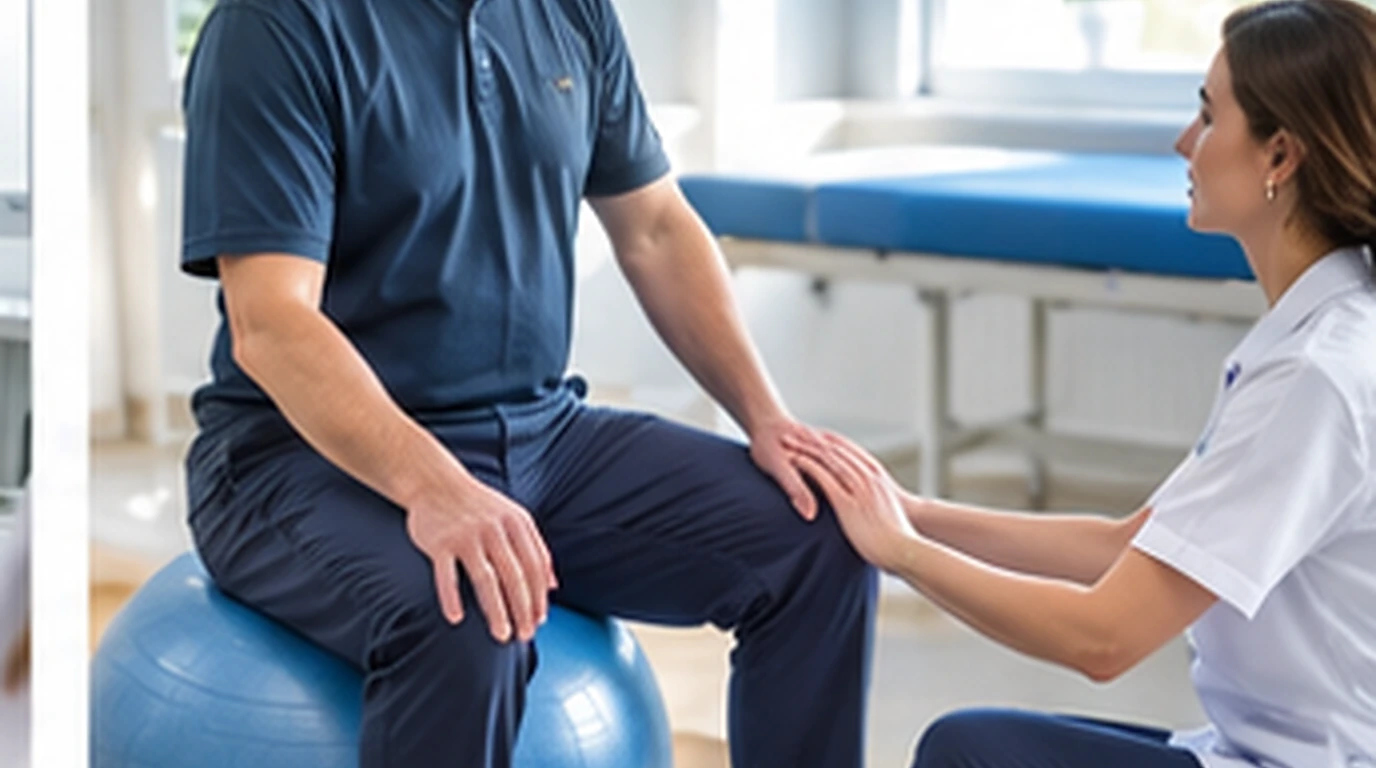
Pelvic floor exercises, which train the muscle that closes the bottom of the pelvis, speed up the return of continence after a prostatectomy.[4] They usually start 7 to 10 days after the catheter comes out.[4] In two trials, written instructions gave results close to supervised sessions, and the added value of sessions with a physiotherapist is still debated.[4] In one trial, supervised training began two months before surgery and continued for a year afterwards. At 12 months, 65 in 100 men no longer used pads, against 32 in 100 who received simple advice.[4]
- Exercises at home suit you if you follow written instructions well.
- Sessions with a physiotherapist suit you if the exercises are hard to do alone, or if leakage is not improving after a few weeks.
06 · If leakage continues
What if leakage stays bothersome?
07 · Day to day
Living with leakage day to day
While leakage lasts, pads for men come in several sizes, depending on how much you leak. Counting the pads you use each day also lets you track your progress. Before work, an outing or prayer, carry a spare pad and empty your bladder. Leakage during sex is possible at first. Passing urine just before often helps. If these problems weigh on your work, your outings, prayer or your life as a couple, tell us: we adapt the advice to your daily life.
08 · Erectile function
How long until erections return?
How erections come back depends on your age, on the stage of the disease, which affects whether the erection nerves can be spared on one side or both, and on the quality of your erections before the operation. We practise nerve sparing, decided case by case. Treatment started early helps erections recover.[6]
09 · Treatment options
Which treatments help erectile dysfunction?
The European guidelines advise starting erection treatment as early as possible after the operation.[6] Tablets (tadalafil, sildenafil) are the first-line treatment.[6] In a trial of men under 68 whose nerves were spared, daily tadalafil improved sexual function at 9 months. The difference disappeared once treatment stopped.[3] The evidence does not support one precise schedule.[3][6]
If tablets are not enough or do not suit you, the European guidelines next propose injections of a medicine (alprostadil) into the penis.[6] A vacuum pump, alone or with tablets, is another option without medicine.[6] If these treatments fail, or if you prefer it, a penile implant can be fitted during an operation.[6]
After the operation there is no ejaculation: orgasm is still possible, but without semen, because the prostate and seminal vesicles have been removed.
Sexual difficulties affect partners too. Couples benefit from talking about them and from support, even though many hesitate to raise the subject.[3] You are welcome to come to the consultation together.
10 · Safety
Warning signs
In Morocco, call 141 (SAMU, the emergency medical service) or go to the nearest emergency department if, after the operation:
- you have a fever (38 °C or more) or shivering
- you cannot pass urine, or the catheter stops draining
- you are bleeding heavily, with clots in your urine
- a calf becomes painful and swollen, or you are short of breath
- you have increasing abdominal pain, or vomiting.
If you have had an operation: call the practice during opening hours, or the emergency number you were given when you left the clinic.
Tell us at your next consultation if leakage increases instead of decreasing, if passing urine burns, or if your stream becomes weak a few weeks after surgery.
11 · Travel planning
Coming from abroad
01
Plan your stay in Casablanca
If you live outside Morocco and plan your operation in Casablanca:
- Before the first visit, send or bring your PSA results, your MRI with its report, your biopsy (pathology) report and a list of your medicines.
- Ask us how long to stay before you book. After an operation, plan to stay about a week in Casablanca on average, to be confirmed at the consultation. The operation takes place at the Centre d’urologie Oasis in Casablanca, and the catheter is removed at the practice a few days later.
- Pelvic floor exercises can be continued at home from written instructions.
- Once you are back home, follow-up (PSA tests, leakage, erections) can be shared with a urologist where you live, and we can stay in contact with them if you wish.
12 · Follow-up
At the practice
At the Centre d’Urologie Casablanca we provide follow-up after prostatectomy: catheter removal, PSA tests, continence and erections. At each visit we review leakage (number of pads a day) and erections, and we adjust exercises and treatment. The operation itself takes place at the Centre d’urologie Oasis in Casablanca.
13 · Your questions
Frequently asked questions
Does the robot protect continence and erections better?
According to the 2023 Moroccan national guideline, studies show no important difference in continence or erections between robotic, laparoscopic and open surgery.[2] These studies are old: they compared surgeons who were starting with the robot to surgeons with years of practice in open or laparoscopic surgery. What also matters is whether the nerves can be spared, your age and how good erections were before surgery.[2]
Does radiotherapy after surgery change anything?
Pelvic radiotherapy makes operations for leakage, such as the sling, less effective and raises the risk of complications with an artificial sphincter. If radiotherapy is planned, we take it into account before suggesting an operation for leakage.[4]
14 · Contact
Book an appointment
Centre d’Urologie Casablanca
22 boulevard Yacoub El Mansour, Office 42, 5th floor, Maârif, 20250 Casablanca, Morocco.
Phone: +212 5 22 77 40 48, Monday to Friday 9 am to 6 pm and Saturday 9 am to 1 pm. Request an appointment online.
Emergency in Morocco: 141 (SAMU) or the nearest hospital emergency department. If you have had an operation: call the practice during opening hours, or the emergency number you were given when you left the clinic.
Our page on robotic surgery describes the robot used in Casablanca.
15 · References
Sources
- 01
Robotic-assisted radical prostatectomy using the Toumai system: initial single-centre experience in Morocco
Et-Touzani R et al. (last author: Ouzzane A). Journal of Robotic Surgery, 2026.
Read the source - 02
Moroccan national guideline: Cancer de la prostate (Référentiel de bonnes pratiques médicales)
2023 edition, ANAM, Ministry of Health and Social Protection, National Council of the Order of Physicians, Moroccan Society of Medical Sciences. Section VI.3 (radical prostatectomy: neurovascular bundles, comparison of surgical routes). In French.
Read the source - 03
EAU Guidelines on Prostate Cancer
European Association of Urology, March 2026 update. Sections 6.2.2.c.1 (nerve sparing) and 8.3.2.a (quality of life after local treatment: incontinence, erectile rehabilitation, couples’ sexual life).
Read the source - 04
EAU Guidelines on the Management of Non-Neurogenic Male LUTS
European Association of Urology, March 2026 update. Sections 5.6.3.b.3 (pelvic floor muscle training), 5.6.4.b (duloxetine), 5.6.5.b (male slings, including cure rates) and 5.6.5.c.1 (artificial urinary sphincter).
Read the source - 05
Patient-Reported Outcomes 12 Years after Localized Prostate Cancer Treatment
Donovan JL et al. (ProtecT trial). NEJM Evidence, 2023.
Read the source - 06
EAU Guidelines on Sexual and Reproductive Health
European Association of Urology, March 2026 update. Section 5.6.10 (erectile dysfunction after radical prostatectomy) and chapter 5 recommendations.
Read the source
This information is general and does not replace a consultation.
Appointments
Request an appointment
The practice team can call you back about your request.
Do not include symptoms, a diagnosis, or other medical information in this form.
Would you rather call? +212 5 22 77 40 48