
Can I work with a JJ stent?
Yes, usually as soon as the pain from the insertion has passed. Hard physical work increases the pain and the blood in the urine: take on lighter tasks while the stent is in.
Urology · Casablanca
A ureteral stent, also called a JJ or double-J stent, is a soft tube placed in the ureter, the tube that carries urine from the kidney to the bladder. It lets urine drain when the ureter is blocked or needs to heal. It is put in through the urinary tract, with no scar on the skin. It must always be removed or changed on the date your urologist sets.
Book an appointment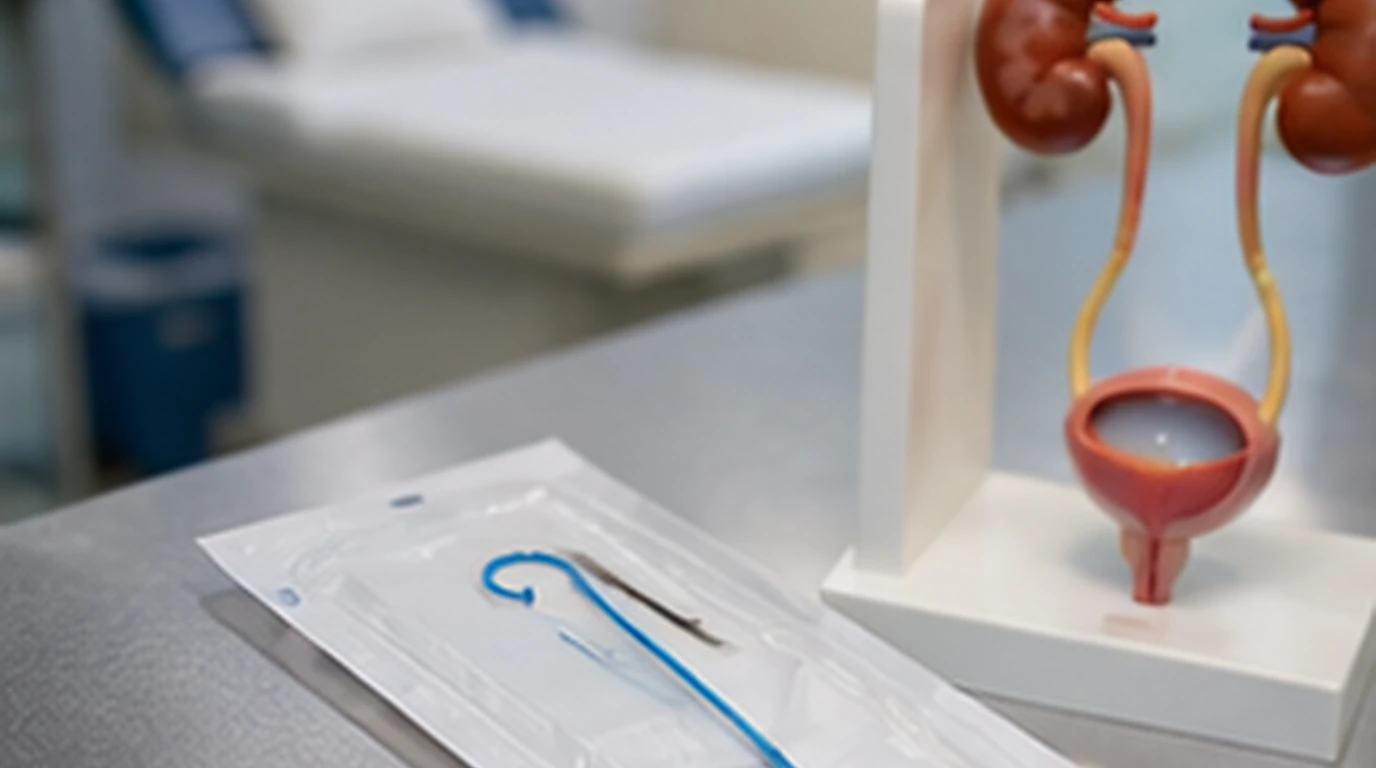
The ureter connects the kidney to the bladder (there is one on each side). The urethra is the tube you pass urine through, from the bladder to the outside. The JJ stent sits in the ureter. To put it in or take it out, the urologist goes through the urethra.
| Question | Answer |
|---|---|
| What is the stent for? | Letting urine pass from the kidney to the bladder when the ureter is blocked, for example by a stone. |
| How is it put in? | In the operating theatre, with a thin camera passed through the urethra, under anaesthetic, usually with no overnight stay or one night. |
| How long does it stay? | One to two weeks before ureteroscopy. A long-term stent is usually changed every 4 to 6 months. Your urologist sets the date. |
| Common discomfort | An urgent need to pass urine, burning, pink urine, pain in the back on the stent side when you pass urine. |
| Warning signs | Fever or shivering, being unable to pass urine: in Morocco, 141 or the emergency department. |
01 / WHY IT IS USED
The most common reason is a stone stuck in the ureter. When the blockage comes with an infection and a fever, the kidney has to be drained urgently. The European Association of Urology (EAU) guidelines rate two methods as equally effective: the JJ stent, put in through the urinary tract, or a small tube passed through the skin of the back into the kidney (a nephrostomy). The stone itself is only treated once the infection has cleared. [1]
A stent is also used:
After a simple ureteroscopy in which the stone has been removed completely, a stent is not routine. [1]
02 / THE PROCEDURE
In Morocco you may hear this called “montée de sonde JJ”. It is done in the operating theatre. The urologist passes a thin camera through the urethra into the bladder, finds the opening of the ureter, then pushes the stent up to the kidney, following its progress on an X-ray screen. One curl of the stent sits in the kidney, the other in the bladder. There is no incision.
The anaesthetic is general, or limited to the lower body (spinal anaesthetic). In a simple case, the stent is usually put in as a day case, so you go home the same day, or with one night in hospital depending on the situation. If the stent is put in for an infection, you stay in hospital until the fever comes down on antibiotics.
03 / HOW LONG IT STAYS
How long it stays depends on why it was put in. When the stent is put in to prepare for a ureteroscopy, the second procedure usually takes place one to two weeks later. [1] A stent put in after an operation stays while the ureter heals, often a few weeks. A stent left in long term, for a compressed ureter, is changed at regular intervals, usually every 4 to 6 months depending on the model: your urologist gives you the date. [2]
The removal date is on the documents you are given when you leave hospital. Write it down and book the appointment in advance. Some stents have a string that comes out through the urethra: removal is simpler and the stent stays in for a shorter time. [1] A stent must never be forgotten. The longer it stays in, the higher the risk of infection. Deposits can also build up and make removal difficult.
04 / EXPECTED EFFECTS
The stent is a foreign body in the bladder. Most people feel:
A medicine from the alpha-blocker family reduces this discomfort and the pain. [1] Your urologist may add medicine to calm the bladder. These medicines are prescribed when the discomfort calls for them. Mention it at your consultation. Drinking regularly keeps your urine clear.
05 / WARNING SIGNS
In Morocco, call 141 (SAMU, the emergency medical service) or go to the nearest emergency department without waiting if you have:
If you are outside Morocco, call your local emergency number. Say that you have a JJ stent. A fever in someone with a JJ stent is an emergency: it can be a sign of a kidney infection. Then let us know. From abroad, you can also write to urocasa@gmail.com. If you have had an operation: call the practice during opening hours, or the emergency number you were given when you left the clinic.
06 / REMOVAL
Most often, the stent is removed by flexible cystoscopy: a thin, flexible camera is passed through the urethra with an anaesthetic gel and no injection. The urologist grips the end of the stent in the bladder and pulls it out. It takes a few minutes and is usually done at the practice, with no hospital stay. If the stent has a string, it is removed without a camera on the planned date. The doctor or nurse removes it by pulling on the string. Never remove it yourself.
Back pain or burning can follow removal for the rest of the day.
07 / TRAVEL
You can travel with a stent. Plan its removal before you leave, because a removal date that falls after you have gone home is easy to miss:
08 / AT THE PRACTICE
At the Centre d’Urologie Casablanca, we explain why the stent is being put in and how long it has to stay, and we set the removal date with you before you leave hospital. The stent is inserted in the operating theatre at the Centre d’urologie Oasis in Casablanca. Removal by flexible cystoscopy is most often done at the practice, with an anaesthetic gel.
09 / QUESTIONS
Yes, usually as soon as the pain from the insertion has passed. Hard physical work increases the pain and the blood in the urine: take on lighter tasks while the stent is in.
Yes, the stent does not prevent it. The discomforts described above (urge to pass urine, burning, back pain) can be stronger during physical effort, but they are not serious and stop once the stent is removed. [2]
Call the practice on +212 5 22 77 40 48 for an early appointment. Do not wait until you have symptoms.
10 / APPOINTMENTS
Centre d’Urologie Casablanca, 22 boulevard Yacoub El Mansour, Office 42, 5th floor, Maârif, 20250 Casablanca, Morocco.
Telephone: +212 5 22 77 40 48, Monday to Friday 9 am to 6 pm and Saturday 9 am to 1 pm (Morocco time). Request an appointment online.
Emergency in Morocco: 141 (SAMU) or the nearest hospital emergency department. Outside Morocco, call your local emergency number. If you have had an operation: call the practice during opening hours, or the emergency number you were given when you left the clinic.
11 / REFERENCES
2026 edition, sections 3.4.2 (drainage of a blocked, infected kidney) and 3.4.6 (ureteroscopy 7 to 14 days after the infection has cleared, no routine stent after a simple ureteroscopy, stents on a string, stent duration and infectious complications, alpha-blockers for stent-related discomfort). There is currently no Moroccan guideline or Moroccan Urology Association (AMU) patient leaflet on JJ stents.
Read the EAU guidelinesOctober 2024 edition (long-term stents changed every 4 to 6 months, discomfort can be stronger during physical activity and stops once the stent is removed). In French.
Read the patient leafletThis information is general and does not replace a consultation.
Appointments
The practice team can call you back about your request.
Do not include symptoms, a diagnosis, or other medical information in this form.
Would you rather call? +212 5 22 77 40 48