
Urinary endoscopy · Casablanca
Cystoscopy (bladder endoscopy): how the test goes
A cystoscopy lets the urologist look directly inside the bladder and the urethra, the tube you pass urine through. A thin, flexible camera goes in through the urethra: in men through the tip of the penis, in women through the urinary opening. At the practice, the test is done with an anaesthetic gel and no injection, and you go home straight afterwards.
Book an appointment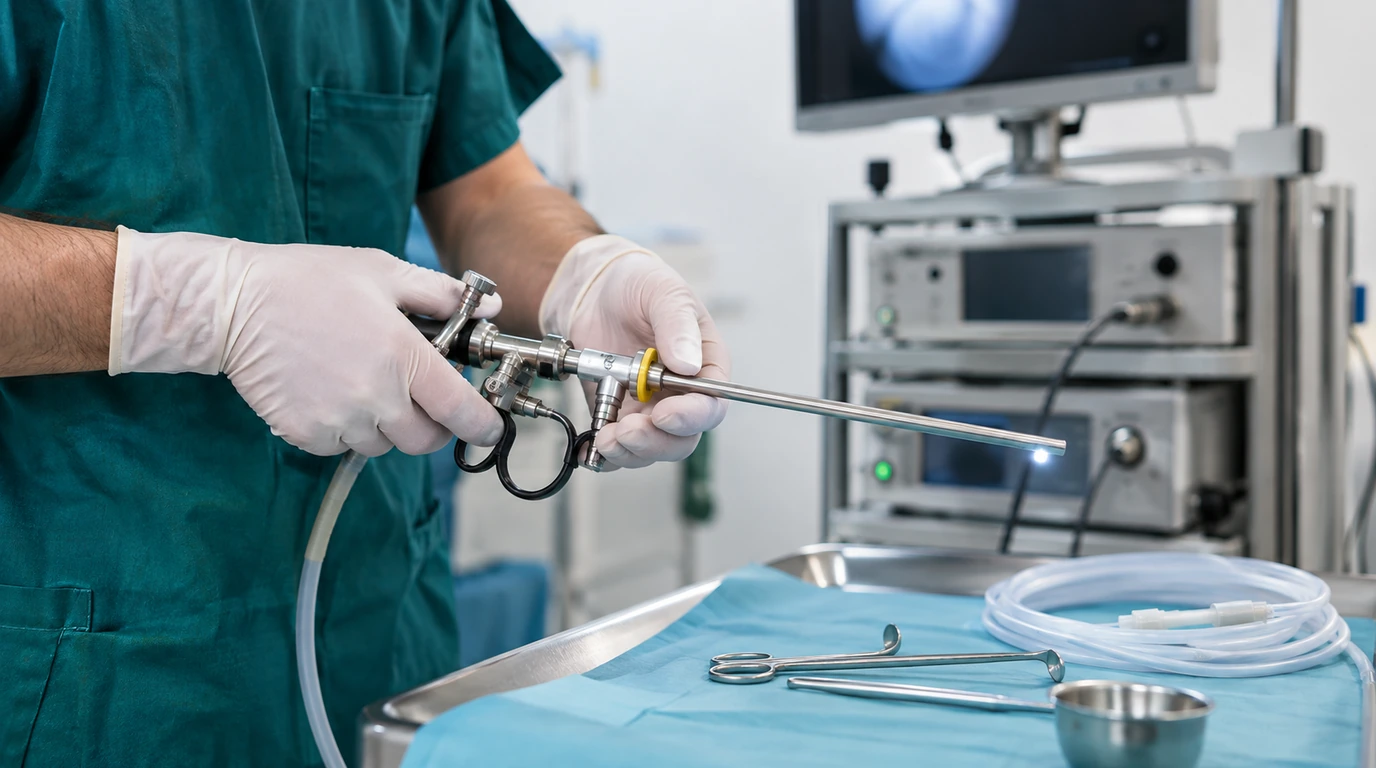
01 / AT A GLANCE
At a glance
| Question | Answer |
|---|---|
| Where does the camera go in? | Through the urethra, the tube you pass urine through. No incision, no injection |
| Anaesthetic | An anaesthetic gel placed in the urethra |
| How long | The test itself takes a few minutes |
| Do I need to fast? | No, it is not necessary |
| Antibiotic before the test | Usually not, if there is no urinary infection [2] |
| Afterwards | Burning and pink urine are possible on the day and the day after |
| Warning signs | Fever (38 °C or more), shivering, clots, being unable to pass urine: in Morocco, 141 or the emergency department |
Appointments: +212 5 22 77 40 48 · Centre d’Urologie Casablanca, Maârif.
02 / WHY IT IS DONE
Why have a cystoscopy?
Your doctor asks for one when the bladder wall has to be seen directly, which ultrasound or a CT scan cannot always do:
- blood in the urine, seen once or found in a urine test
- monitoring after a bladder tumour has been removed
- difficulty passing urine, when a narrowing of the urethra, a stone or a polyp is suspected
- removal of a JJ stent (ureteral stent).
Blood in the urine often has a benign cause, such as an infection or a stone. The point of the test is not to miss a tumour, which is treated more successfully when found early. The 2023 Moroccan national guideline on bladder cancer states that diagnosis of a bladder tumour rests on this test. After a tumour has been removed, a check cystoscopy is done 3 months later. For low-risk tumours, these checks can stop after 5 years without recurrence. [1]
03 / BEFORE THE TEST
How to prepare
- You do not need to fast: you can eat and drink normally.
- A urine test (a urine culture, called ECBU in Morocco and France) is requested before the test. If there is an infection, it is treated first and the test is postponed.
- For a test without a urinary infection, European guidelines do not call for a preventive antibiotic. [2]
- Tell us about any blood-thinning medicines and any allergies. Do not stop any medicine on your own.
- Bring your latest results: ultrasound, CT scan and urine tests.
04 / THE PROCEDURE
How the test goes
You lie on your back. The area is cleaned, then an anaesthetic gel is placed in the urethra. The urologist gently passes the flexible camera into the bladder and fills it with sterile water to unfold its wall. You then feel the need to pass urine: this is normal and stops as soon as the water is let out. You can watch the test on the screen. The test itself takes only a few minutes. Allow a little longer for getting settled and for explanations.
The Moroccan guideline notes that a flexible instrument with an anaesthetic gel is better tolerated than a rigid one, especially in men. [1] In men, the urethra is longer and passes through the prostate, which makes the test a little more uncomfortable. In women, it is short and the test is quicker. The practice has information leaflets for each:
- Cystoscopy leaflet for men (PDF, in French)
- Cystoscopy leaflet for women (PDF, in French)
05 / WHAT TO EXPECT
Does it hurt?
For most people, the test is uncomfortable rather than painful. You feel the camera going in, but the gel dulls the sensation. The most unpleasant moment is often when the bladder is filled.
06 / AFTER THE TEST
What happens afterwards?
You go home straight after the test and you can drive. On the day and the day after, burning when passing urine, needing to go more often and pink urine are common. Drink regularly. Discomfort that lasts more than two days is a reason to call the practice on +212 5 22 77 40 48.
If you have a fever (38 °C or more), shivering, very red urine with clots or you cannot pass urine: in Morocco, call 141 (SAMU, the national emergency medical service) or go to the nearest emergency department. If you are outside Morocco, call your local emergency number. Then let us know: call the practice during opening hours, or the emergency number you were given when you left the clinic.
07 / AT THE PRACTICE
Cystoscopy at the Centre d’Urologie Casablanca
At the Centre d’Urologie Casablanca, we carry out flexible cystoscopy on site, with a high-definition camera, an anaesthetic gel and no injection. We use an Olympus endoscopy system with NBI imaging (“Narrow Band Imaging”). This filtered light makes the blood vessels in the bladder wall more visible. The Moroccan guideline states that it improves the detection of bladder tumours. [1]
The urologist tells you what they saw as soon as the test is over.
08 / RESULTS
What if the test shows something abnormal?
The urologist marks on a diagram of the bladder the position, size, number and appearance of what was seen. [1] The image alone is not enough to conclude: the diagnosis of a tumour rests on examining a sample of tissue under the microscope, taken by a small biopsy or by a resection. [1] A tumour is removed in the operating theatre, under anaesthetic, through the urinary tract and with no incision: this is transurethral resection of a bladder tumour (TURBT), during which the whole bladder is examined again. [1] The tissue removed goes to the laboratory, and the next step of treatment is decided on that result. An analysis of the cells in the urine (cytology) can add to it. [1]
09 / INTERNATIONAL PATIENTS
Coming from abroad
If you live outside Morocco and plan your cystoscopy in Casablanca:
- Before you travel, send or bring your latest ultrasound or CT scan (report and images), your urine tests and a list of your medicines, including blood thinners. To ask how to send them, call the practice or write to urocasa@gmail.com. If the cystoscopy is a check after a bladder tumour was removed, also bring the resection report and the laboratory result.
- The test itself takes a few minutes and you go home straight afterwards. Ask when you book how long to stay in Casablanca before flying home, in case the test shows something that needs a biopsy or a resection in the operating theatre.
- Ask for the written report of your cystoscopy before you leave.
- Check cystoscopies after a bladder tumour start 3 months after its removal [1]. They can be shared with a urologist where you live, using that report.
10 / QUESTIONS
Frequently asked questions
Why do I need a urine test beforehand?
To check that there is no infection. Passing a camera into an infected bladder can spread the infection upwards: the test is then postponed until after treatment.
11 / APPOINTMENTS
Book an appointment
Centre d’Urologie Casablanca, 22 boulevard Yacoub El Mansour, Office 42, 5th floor, Maârif, 20250 Casablanca, Morocco.
Telephone: +212 5 22 77 40 48, Monday to Friday 9 am to 6 pm and Saturday 9 am to 1 pm (Morocco time). Request an appointment online.
12 / REFERENCES
Sources
- 01
Moroccan national guideline: “Cancer de la vessie”
2023 edition (ANAM, Ministry of Health and Social Protection), chapters “Diagnostic, 7. Cystoscopie” and “Surveillance des TVNIM” (monitoring of non-muscle-invasive bladder tumours), distributed by the Moroccan Urology Association (AMU). In French.
View guideline - 02
European Association of Urology, “Guidelines on Urological Infections: Summary of the 2024 Guidelines”
European Urology, 2024, table 19 (no antibiotic prophylaxis recommended for cystoscopy), distributed by the Moroccan Urology Association (AMU).
View recommendations
This information is general and does not replace a consultation.
Appointments
Request an appointment
The practice team can call you back about your request.
Do not include symptoms, a diagnosis, or other medical information in this form.
Would you rather call? +212 5 22 77 40 48