Urologie Casablanca
Menu
Appointments

Appointments · Casablanca

Request an appointment

Enter your contact details and the reason for your request. This request does not confirm an appointment.

For a medical emergency, contact your local emergency services. Do not include symptoms, a diagnosis, or medical information in this form.

The practice collects this information to call you back. Your rights: Privacy and legal information.

Urology · Casablanca

The prostate: what it does, its size and common conditions

The prostate grows with age, which is normal. Its size alone does not tell you whether it is diseased.

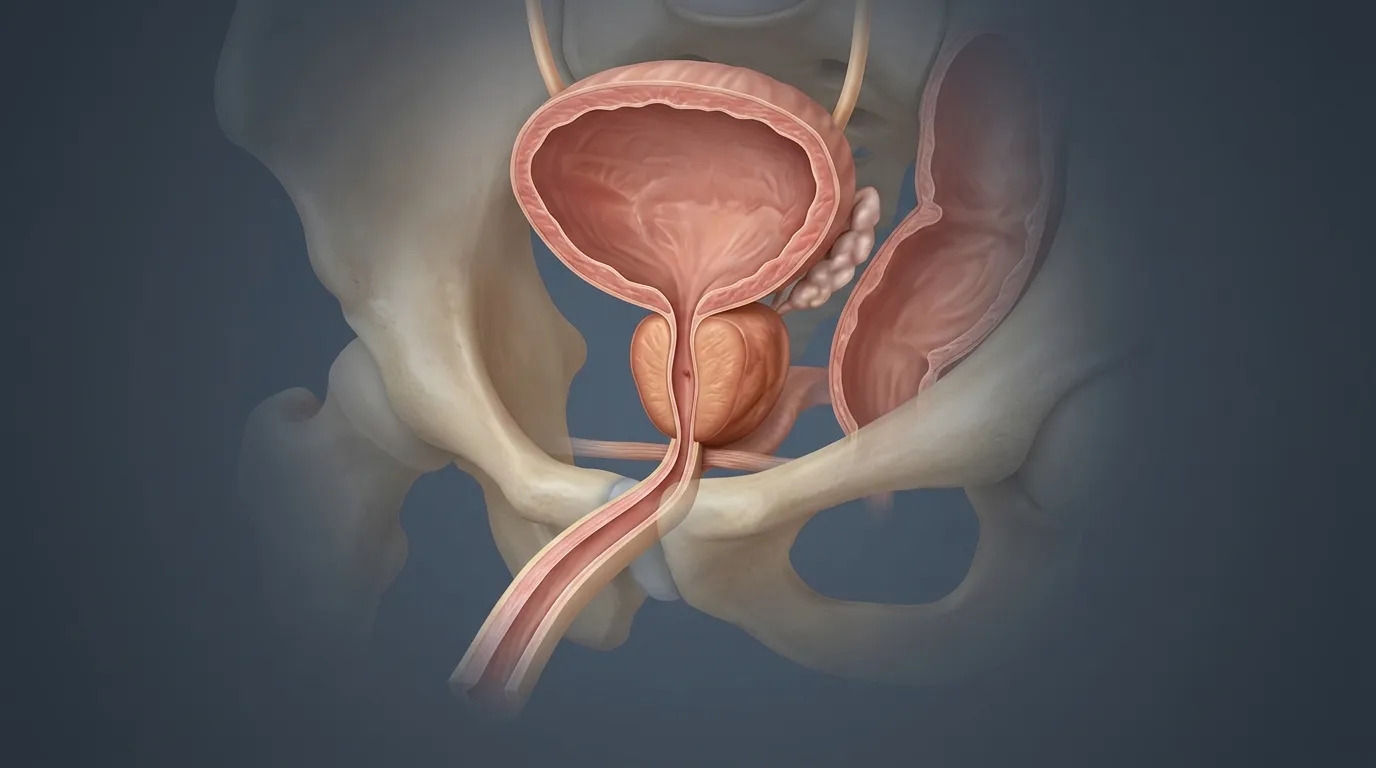
It is a gland found in men, below the bladder and around the tube that carries urine out of the body.

Signs to discuss with a doctor: difficulty passing urine, blood in the urine or a raised PSA. PSA is a protein made by the prostate and measured with a blood test.

Book an appointment
Anatomical illustration of the prostate, bladder and urethra.
Urology · Centre d’Urologie Casablanca

KEY FACTS

The prostate at a glance

Where is it?
Below the bladder, around the start of the urethra, just in front of the rectum. [1]
What does it do?
It makes part of the fluid in semen, and a protein, PSA, that is measured in the blood.
In a young adult15–20 mL

about 15 to 20 grams [1]

01 / URINATION

Why the prostate can make passing urine difficult

The urethra, the tube that carries urine out of the bladder, runs through the prostate. [1] When the prostate grows, it can squeeze this tube: the stream becomes weak, the bladder empties poorly, and you need to pass urine more often, especially at night. Yet an enlarged prostate can cause no trouble at all, and a prostate of average size can block the urine. The guidelines give no normal size by age. The decision rests on how much the symptoms bother you and on the examination.

02 / COMMON CONDITIONS

Enlarged prostate, cancer, prostatitis: what you notice

You pass urine less well and get up at night

Most often this is an enlarged prostate, known as benign prostatic hyperplasia (BPH): a growth of the prostate that is not cancer and is very common with age. An enlarged prostate does not turn into a cancer. It is monitored or treated with medicines or an operation, depending on how much it bothers you: see enlarged prostate (BPH).

You have no symptoms, but a raised PSA

A raised PSA can come from an enlarged prostate, inflammation or infection, or from a cancer. Prostate cancer is the second most common cancer in men in Morocco, after lung cancer, with about 3,500 new cases estimated for 2024. [3] At an early stage it usually causes no symptoms. This is why a PSA test and a rectal examination are used for early detection. [4] PSA testing is offered, after talking it over with a doctor, from 50. It is offered from 45 if your father or brother had prostate cancer or if you are of sub-Saharan African origin, and from 40 if you carry a BRCA2 gene change. [4] See PSA testing and prostate cancer.

You have a fever and burning when you pass urine

This may be acute prostatitis, an infection of the prostate: fever, chills, burning when you pass urine, pain low in the belly or between the scrotum and the anus. It is treated with antibiotics. Not every prostatitis is an infection: fewer than one in ten has a proven bacterial cause, and the long-lasting (chronic) forms are most often pelvic pain with no germ found. [5] Prostatitis raises the PSA for a few weeks, so it is better to wait until you have recovered before repeating the test.

03 / EXAMINATION

The rectal examination

The doctor feels the size, firmness and surface of the prostate with a gloved finger passed into the rectum. It takes a few seconds. It is uncomfortable but rarely painful. This examination is not systematic: it is done when it is indicated. The 2023 Moroccan national guideline combines it with the PSA test for early detection. [4] A prostate that feels hard or irregular leads to further tests: an MRI, and sometimes a biopsy, meaning small samples of prostate taken for analysis.

04 / WHEN TO SEEK CARE

When to see a doctor, and how quickly

In Morocco, call 141 (SAMU, the emergency medical service) or go to the nearest emergency department if:

  • you cannot pass urine at all, and your lower belly is tight and painful
  • you have a fever of 38 °C or more, or chills, with burning when you pass urine or pain low in the belly.

If you are outside Morocco, call your local emergency number.

Book a consultation within two weeks if you see blood in your urine or in your semen.

Book a routine consultation for a stream that is getting weaker, getting up at night often enough to disturb your sleep, or a raised PSA.

05 / TRAVEL

Coming from abroad

If you live outside Morocco and plan a consultation in Casablanca:

  • Before you travel, send or bring your latest PSA results, your ultrasound or MRI reports (with the CD if you have one) and a list of your medicines, so they can be used at the first consultation. To ask how to send them, call the practice or write to urocasa@gmail.com.
  • If a test or an operation is suggested, ask at the consultation how long you will need to stay in Casablanca. The operations for an enlarged prostate are described on our enlarged prostate page.
  • Ask for a written report of the consultation and of any test done, so that a urologist where you live can take over the follow-up.

06 / AT THE PRACTICE

At the practice

At the practice, we carry out the examination, the ultrasound scan, the urine flow test, which measures the strength of your stream, and, when it is needed, the MRI fusion prostate biopsy, which can also be done at the clinic. For the first consultation, bring your latest PSA results, your ultrasound or MRI reports and a list of your medicines.

07 / QUESTION

Frequently asked question

Can a food or a herbal tea treat the prostate?

No food or herbal tea cures an enlarged prostate or a cancer. European guidelines only recognise a modest effect on the symptoms of an enlarged prostate for some saw palmetto extracts, prepared in a particular way. [2] Talk to us before taking any, especially if you are already on treatment.

08 / APPOINTMENTS

Booking an appointment

Centre d’Urologie Casablanca, 22 boulevard Yacoub El Mansour, Office 42, 5th floor, Maârif, 20250 Casablanca, Morocco.

Telephone: +212 5 22 77 40 48, Monday to Friday 9 am to 6 pm and Saturday 9 am to 1 pm (Morocco time). Request an appointment online.

09 / REFERENCES

Sources

  1. 01

    Moroccan Urology Association (AMU), patient leaflet “Biopsie de la prostate”

    Description of the prostate, normal weight of 15 to 20 grams. In French.

    Read the leaflet
  2. 02

    European Association of Urology (EAU), Pocket Guidelines, Non-neurogenic Male LUTS, 2025

    Prostate volume above 40 mL as a risk factor for worsening. Saw palmetto extracts. There is currently no Moroccan guideline on enlarged prostate.

    Read the EAU guidelines
  3. 03

    International Agency for Research on Cancer, GLOBOCAN 2024, Morocco fact sheet

    Estimates for 2024: 3,533 new cases.

    Read the Morocco fact sheet
  4. 04

    Moroccan national guideline (Référentiel de bonnes pratiques médicales) “Cancer de la prostate”, 2023 edition

    ANAM, Ministry of Health and Social Protection, National Council of the Order of Physicians, Moroccan Society of Medical Sciences. Sections III.2 (early detection) and IV.1 (rectal examination). In French.

    Read the guideline
  5. 05

    European Association of Urology (EAU), Guidelines on Urological Infections, 2026

    Section 3.11.3 (fewer than 10% of prostatitis cases have a proven bacterial infection).

    Read the EAU guidelines

This information is general and does not replace a consultation.

Appointments

Request an appointment

The practice team can call you back about your request.

Do not include symptoms, a diagnosis, or other medical information in this form.

Would you rather call? +212 5 22 77 40 48

Call