
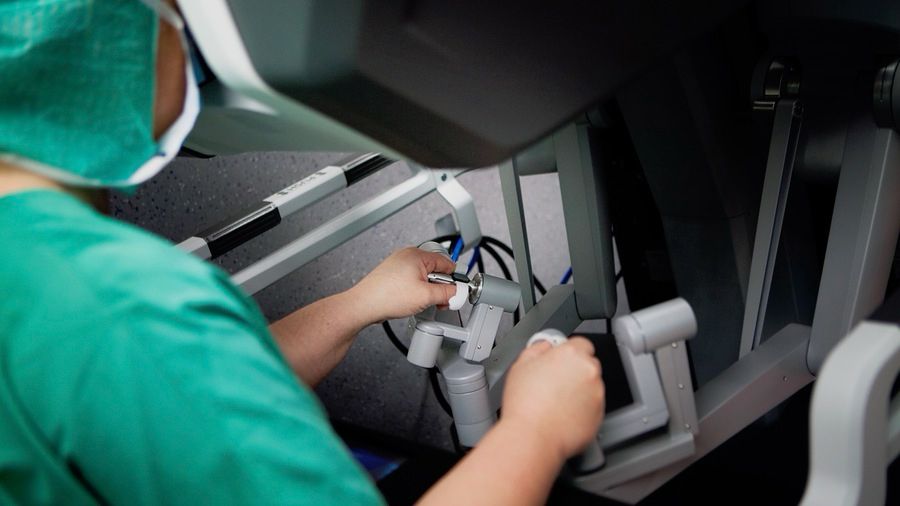
A console and a magnified view
The Toumai system is the surgical robot we use: a console where the surgeon sits, and a cart beside the patient whose arms hold the instruments.
Urology · Casablanca
Learn how robotic surgery works, which urological operations use it in Casablanca, what early results show and what to know before an operation.
01 · The essentials
Since December 2024, we have operated with the Toumai surgical robot at the Centre d’urologie Oasis in Casablanca (Akdital group), mainly to remove the prostate for cancer.[5] The surgeon works from a console and controls fine instruments passed through small cuts in the abdomen.
Appointments: +212 5 22 77 40 48 · Centre d’Urologie Casablanca, Maârif.
02 · Published series
Our team published its first 132 robotic prostatectomies, done in Casablanca between December 2024 and October 2025.[5] These are early results from one centre, measured over the first three months.
| Result | Out of 100 men |
|---|---|
| Continent (no bothersome leakage) when the catheter came out | 30 |
| Continent at 6 weeks | 83 |
| Continent at 3 months | 92 |
| Cancer found at the edge of the removed tissue (positive margin) | 6 |
| Complications, all minor (none needed a new operation under general anaesthesia) | 6 |
Half of the operations lasted less than 2 hours 35 minutes. None had to be finished as open surgery, and no robot failure made the team change technique.[5]
Recovery of bladder control and erections, and what helps, is explained on our page about incontinence and erections after prostatectomy.
These findings come from one centre and a short follow-up period, so they should be read as preliminary results.
03 · The procedure
The Toumai system is the surgical robot we use: a console where the surgeon sits, and a cart beside the patient whose arms hold the instruments.
At the console, the surgeon sees the operating area in three dimensions, magnified. The surgeon’s hand movements are reproduced by the instruments inside the body. The robot takes no decisions of its own.[1]
The surgeon cannot feel the tissue through the instruments. Instead, the magnified image shows how the tissue reacts when it is held or pulled. Learning to work without touch is a specific part of robotic training, for the surgeon and the whole operating team.[1]
04 · Indications
We use the robot mainly for operations in narrow spaces:
Removal of the prostate for cancer. Read about radical prostatectomy
Kidney operations such as partial nephrectomy, which removes a kidney tumour and keeps the rest of the kidney, and adrenal gland surgery.[2]
Removal of the bladder for cancer, performed by Dr Alae Touzani [3] and Prof Adil Ouzzane, with the robot as first choice.
Some repairs of the urinary tract.[1]
05 · Benefits and limits
The 2023 Moroccan national guideline finds no important difference in cancer control, continence or erections between robotic, laparoscopic and open prostatectomy.[4] The studies that showed no major difference between robotic, laparoscopic and open surgery are old: they compared surgeons who were starting with the robot to surgeons with years of practice in open or laparoscopic surgery.
Small-incision surgery, with or without the robot, causes less bleeding and a shorter hospital stay than open surgery.[4]
We use the robot because, in the narrow space around the prostate, the magnified 3D view and fine instruments make delicate work through small cuts easier for the surgeon.[1] For us, what makes the difference is the surgeon’s experience and knowledge of anatomy, more than the machine.[1]
06 · Your care
The operation is done under general anaesthetic. Most patients go home the next day. You go home with a urinary catheter, which stays for a few days and is removed at a consultation.
If you have had an operation: call the practice during opening hours, or the emergency number you were given when you left the clinic.
07 · Travel planning
If you plan to travel to Casablanca for surgery:
PSA tests and checks of bladder control can be done where you live. We agree with you how your results reach us.
08 · Casablanca
At the Centre d’Urologie Casablanca, we first check in consultation whether an operation is useful and which technique suits your case. For prostate cancer, the diagnosis rests on an MRI-guided biopsy. Prof Ouzzane has operated with surgical robots since 2008[2], starting at Lille University Hospital. He chairs the Moroccan Society of Robotic Surgery, whose secretary general is Dr Touzani.[6][3]
Prof Ouzzane’s profile09 · Questions
Both use small cuts. In standard laparoscopy, the surgeon holds long, straight instruments. With the robot, the surgeon controls jointed instruments from a console and sees a 3D image.[1]
The robot has a maintenance contract with regular checks, and the operating theatre has a backup power supply. If the robot had to be stopped, the team is trained to finish the operation with another technique.[1] In our first 132 robotic prostatectomies, no robot failure made the team change technique.[5]
10 · Contact
Centre d’Urologie Casablanca
22 boulevard Yacoub El Mansour, Office 42, 5th floor, Maârif, 20250 Casablanca, Morocco.
Telephone
+212 5 22 77 40 48
Monday to Friday 9 am to 6 pm and Saturday 9 am to 1 pm (Morocco time).
Emergency
141 (SAMU) or the nearest hospital emergency department. If you have had an operation: call the practice during opening hours, or the emergency number you were given when you left the clinic.
Consultations are in French, Arabic and English.
References
Hespress, interview with Prof Adil Ouzzane, October 2026 (in French).
Read the sourceCentre d’Urologie Casablanca · specialties and professional profile.
View the profileCentre d’Urologie Casablanca · specialties and professional profile.
View the profile2023 edition, ANAM, Ministry of Health and Social Protection, National Council of the Order of Physicians and Moroccan Society of Medical Sciences, section VI.3 (radical prostatectomy, surgical approaches).
Read the sourceEt-Touzani R et al. (senior author: Ouzzane A). Journal of Robotic Surgery, 2026.
Read the sourceThis information is general and does not replace a consultation.
Appointments
The practice team can call you back about your request.
Do not include symptoms, a diagnosis, or other medical information in this form.
Would you rather call? +212 5 22 77 40 48