
The length of your stay depends on your recovery and the hospital [2].
Urinary diversion · Casablanca
Urostomy (ileal conduit, Bricker): living with a urine bag
After the bladder is removed (cystectomy), an ileal conduit, also called a Bricker, gives urine a new way out. The ureters are joined to a short piece of bowel that opens onto the skin of the abdomen through a small opening, the stoma. Urine flows continuously into a bag worn around it: this is a urostomy, or urinary stoma. Here is what to expect from the operation, stoma care and life afterwards.
01 · Key points
In short
After the bladder is removed (cystectomy), an ileal conduit, also called a Bricker, gives urine a new way out. The ureters, which carry urine from the kidneys, are joined to a short piece of bowel that opens onto the abdomen through a small opening called the stoma. Urine flows continuously into a bag attached around it: this is a urostomy, or urinary stoma. For cancer, the result is the same as with a new bladder (neobladder) [1].
Appointments
+212 5 22 77 40 48 · Centre d’Urologie Casablanca, Maârif.
02 · Practical guide
The ileal conduit at a glance
03 · The procedure
How is an ileal conduit made?
Removing the bladder also removes the lymph nodes in the pelvis, the small glands that filter fluid from the area. In men, it removes the prostate and seminal vesicles (two small nearby glands). In women, it removes the urethra, the womb and part of the vagina next to the bladder [1], and sometimes the ovaries [6].
The surgeon takes a short piece from the end of the small bowel (the ileum) and rejoins the bowel, which then works normally. The two ureters are joined to one end of this piece. The other end is brought out through a small opening in the skin, usually to the right of the navel: this is the stoma [2]. The piece of bowel does not store urine. It carries it to the skin, hence the name ileal conduit [2]. While the joins heal, thin tubes run through the ureters and drain urine into the bag [2].
In the UK, the operation takes 4 to 6 hours with an ileal conduit and 2 to 6 hours with a neobladder: the ranges overlap, and the length depends on each case [2] [7]. The hospital stay there is 7 to 14 days [2]. Ask at your consultation how long it usually is at the Centre d’urologie Oasis in Casablanca, where our urologists operate.
Ureter and urethra after an ileal conduit
The tube that carries urine from a kidney. With an ileal conduit, it carries urine to the piece of bowel.
The channel you used to pass urine through. It is no longer used for that after an ileal conduit.
04 · Learning the routine
Learning to care for the stoma
In the UK, a nurse who specialises in stomas (a stoma nurse) sees the patient before the operation to show them the bags, then, before discharge, teaches them to clean the stoma and change the bag. It helps if someone close learns too [3]. Ask at your consultation who will teach you at the Centre d’urologie Oasis in Casablanca, and bring the person who will help you at home.
05 · Everyday life
Living with a urostomy bag
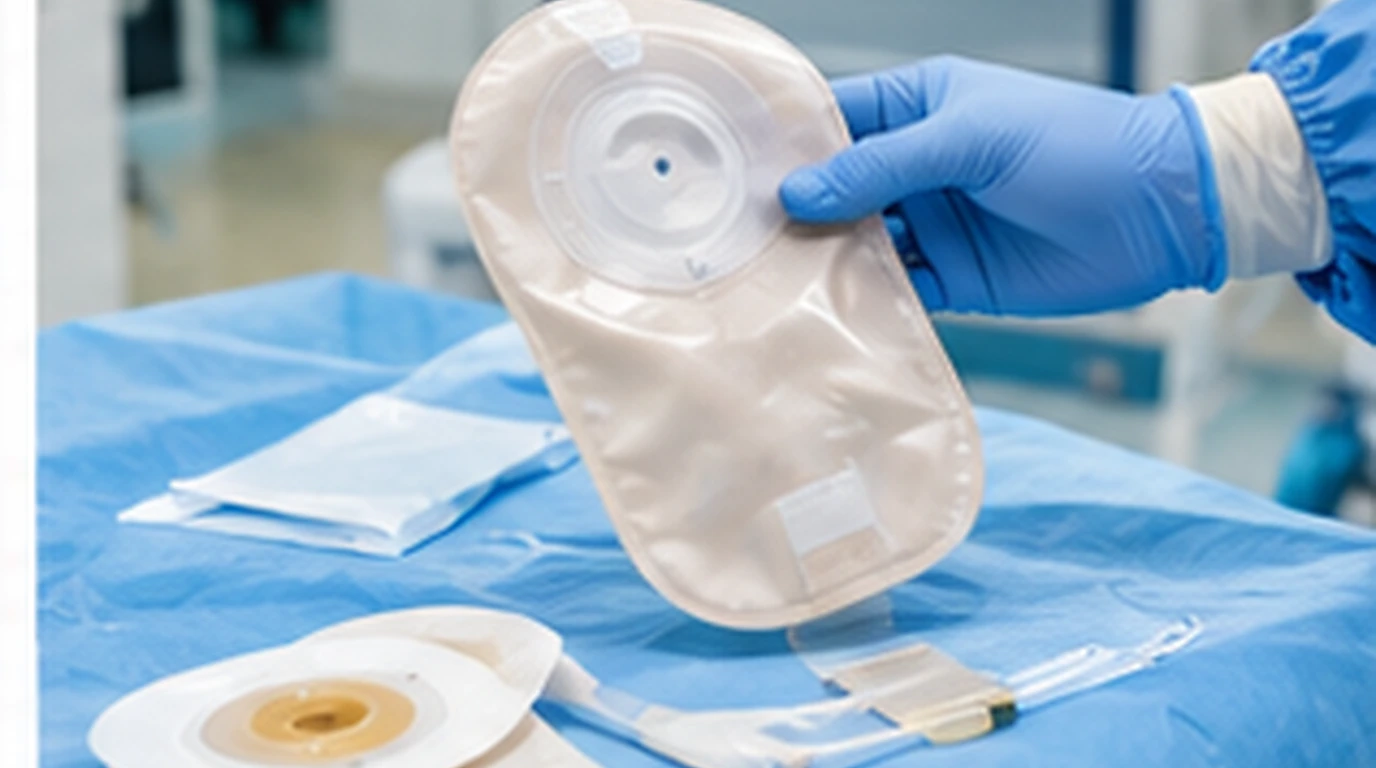
Emptying the bag is the everyday task: it empties into the toilet through a small tap, and at night you can connect it to a larger night bag so you can sleep without getting up [5]. Flat and sealed, it cannot be seen under ordinary clothes [3].
Changing it depends on the system [3]. A one-piece bag can last up to 3 days, but changing it daily is advised. With a two-piece system, the base plate stuck to the skin is changed every 2 to 3 days and the bag every day or every other day. When changing, cut the opening in the base plate to the exact size of the stoma, because the closer the fit, the less the bag leaks. Clean the skin with warm water, dry it well, then press the new base plate on with warm fingers for 5 to 10 minutes so it seals. It does not need to be sterile, but your hands should be clean [3].
Several things are surprising at first and are normal. The stoma is red like the inside of your mouth and has no nerves, so touching it does not hurt. Swollen after the operation, it becomes smaller as it heals. A little blood when you clean it stops within a few minutes, and white threads of mucus in the bag decrease over time [2]. Blood coming from inside the stoma, on the other hand, should be reported to a doctor [2]. Bowel movements may also become looser because the bowel is a little shorter. This often improves, but not always [5].
06 · Intimacy
Sex life with a urostomy
When it fits well, the urostomy bag cannot be seen under clothes and should not leak [5]. If the stoma changes how you feel about your body or about sex, say so at the consultation, alone or with your partner [6].
In men, removing the prostate ends ejaculation, and the operation can affect the nerves that control erections. Tablets, injections into the penis, a vacuum pump or an implant can help [6]. In women, the vagina may be shorter or narrower. Dilators and gels for dryness help, and removing the ovaries brings on menopause straight away [6]. Sparing the nerves or some organs is only discussed when the cancer allows it [1].
07 · Understanding risks
Risks of cystectomy with an ileal conduit
A cystectomy with an ileal conduit is still major surgery. The figures below come from the 2023 Moroccan guideline, except the stoma row, which comes from European guidelines. They are lower with surgeons and hospitals that perform many cystectomies [1] [4].
Death
1.2 to 3.2 per 100 patientsDeath
2.3 to 8 per 100 patientsA complication
58 in one large single-centre study per 100 patientsA repeat operation
About 12 per 100 patientsLate complication, such as narrowing where a ureter joins the bowel or reduced kidney function
Up to 30 in some studies per 100 patientsA stoma problem, such as narrowing
Up to 24 per 100 patientsA complication of the new urine route
45 per 100 patientsA complication of the new urine route
More than 54 per 100 patientsEach row counts one type of complication over its own period, so these figures cannot be added together.
What these complications are, and how they are treated:
- Urine infection, including kidney infection (pyelonephritis): antibiotics and plenty of fluids [1] [2].
- Urine leak where a ureter joins the piece of bowel: a serious problem, treated straight away by drainage, sometimes followed by an operation [1] [8].
- Narrowing of that join, sometimes years later: the surgeon can stretch it and place a thin tube to keep it open. Sometimes an operation is needed [1] [8].
- Bowel slow to start working after surgery: a drip, sometimes a tube through the nose into the stomach. It gets better with time [8].
- Irritated skin around the stoma, often because the bag does not fit well: show it to your stoma nurse or doctor [2].
- Hernia, a bulge next to the stoma: a support belt is sometimes enough. Otherwise it can be repaired in an operation [2].
- Urinary stones in the long term [1].
08 · When to get help
Warning signs with a urostomy
Outside Morocco, call your local emergency number.
If you have had an operation: call the practice during opening hours, or the emergency number you were given when you left the clinic.
Tell us at your next consultation about red or sore skin under the base plate, repeated leaks from the bag, or a stoma that narrows or bulges.
09 · After surgery
Stoma and cancer follow-up
Follow-up combines CT scans to check the cancer every six months until the third year, then once a year, checks of the stoma and kidney blood tests [1]. It lasts for life because complications of the new urine route can appear years after surgery (see the risk table) [1]. At the practice, we check the stoma after the operation.
10 · The options
Why an ileal conduit rather than another option?
The indications for cystectomy, its timing, chemotherapy before surgery and the choice between robotic and open surgery are the same as for a neobladder and should be discussed with your urologist.
Once the bladder is removed, urine can leave the body in three ways [1]. With a neobladder, it leaves through the urethra by pushing with the abdominal muscles: this is the most complex reconstruction, and you have to learn to pass urine again. With an ileal conduit, it leaves through the stoma into a bag, with no retraining. With a cutaneous ureterostomy, the ureters are joined directly to the skin: narrowing and infection are more frequent, and this option is kept for operations done to relieve symptoms or for patients whose condition does not allow another diversion [1]. The 2023 Moroccan guideline therefore describes the ileal conduit as a good compromise [1].
An ileal conduit is often a good choice if a more complex reconstruction would put you at too much risk, if you would not be able to empty a neobladder yourself with a catheter, or if a neobladder is not possible, for example with cancer of the urethra or severe kidney or liver failure. If you are in good shape and ready to learn to pass urine again, a neobladder is worth discussing [1] [2]. Age alone does not decide, but over 80 an ileal conduit is usually advised [1] [2].
11 · Planning your visit
Coming from abroad for a urostomy
If you live outside Morocco and plan your operation in Casablanca:
- Before the first visit, send or bring your tumour resection report (the microscope examination of the tumour), your CT or MRI with its report, recent kidney blood tests and a list of your medicines.
- The hospital stay is when you, and ideally a family member, learn to empty and change the bag [3].
- Before you fly home, write down the brand and reference of your bags and base plates, and check that you can get the same ones where you live.
12 · Common questions
Frequently asked questions
Can I go back to work?
Yes, usually, after some recovery time, except for heavy physical work such as construction or warehouse work: discuss it before you return. You also need access to a toilet to empty the bag [5].
Can I exercise and swim?
Yes, exercise and swimming remain possible. For swimming, you can wear a smaller bag or cover the stoma with a waterproof dressing [5].
13 · Contact
Book an appointment
Centre d’Urologie Casablanca
22 boulevard Yacoub El Mansour, Office 42, 5th floor, Maârif, 20250 Casablanca, Morocco.
Phone: +212 5 22 77 40 48, Monday to Friday 9 am to 6 pm and Saturday 9 am to 1 pm (Morocco time). Request an appointment online.
Emergency in Morocco: 141 (SAMU) or the nearest hospital emergency department. Outside Morocco, call your local emergency number. If you have had an operation: call the practice during opening hours, or the emergency number you were given when you left the clinic.
14 · References
Sources
- 01
Bladder cancer · Moroccan good medical practice guideline
2023 edition, Ministry of Health and Social Protection, ANAM and Moroccan Urology Association. Sections on urinary diversion, Bricker ileal conduit, neobladder, morbidity and mortality, sexual function and follow-up. In French.
View source - 02
- 03
- 04
Guidelines on Muscle-invasive and Metastatic Bladder Cancer
European Association of Urology, 2026 edition, consulted November 2026. Long-term stoma problems.
View source - 05
Living with a urostomy, urine pouch or new bladder
Cancer Research UK, reviewed 24 September 2025.
View source - 06
- 07
- 08
This information is general and does not replace a consultation.
Appointments
Request an appointment to discuss an ileal conduit
The practice team can call you back about your request.
Do not include symptoms, a diagnosis, or other medical information in this form.
Would you rather call? +212 5 22 77 40 48