
In the United States, survival 10 years after diagnosis is about 97% (men diagnosed between 2001 and 2016). The same passage of the guideline gives 76% for central and southern European countries and 88% for eastern European countries, with no time period given for these figures.[1]
Urology · Casablanca
Prostate cancer: diagnosis and treatment
Most men who are found to have prostate cancer do not die of it: caught early, it can often be cured, and many slow-growing cancers can be monitored without treatment. In its early stages it usually causes no symptoms. It is found through a blood test (PSA), then confirmed by MRI and biopsy.
01 · The essentials
Key points
Most men who are found to have prostate cancer do not die of it: caught early, it can often be cured, and many slow-growing cancers can be monitored without treatment. In its early stages it usually causes no symptoms. It is found through a blood test (PSA), then confirmed by MRI and biopsy.
Already have a biopsy report?Go straight to reading the reportAppointments: +212 5 22 77 40 48 · Centre d’Urologie Casablanca, Maârif.
02 · Quick guide
At a glance
03 · Signs and testing
Symptoms, risk factors and testing
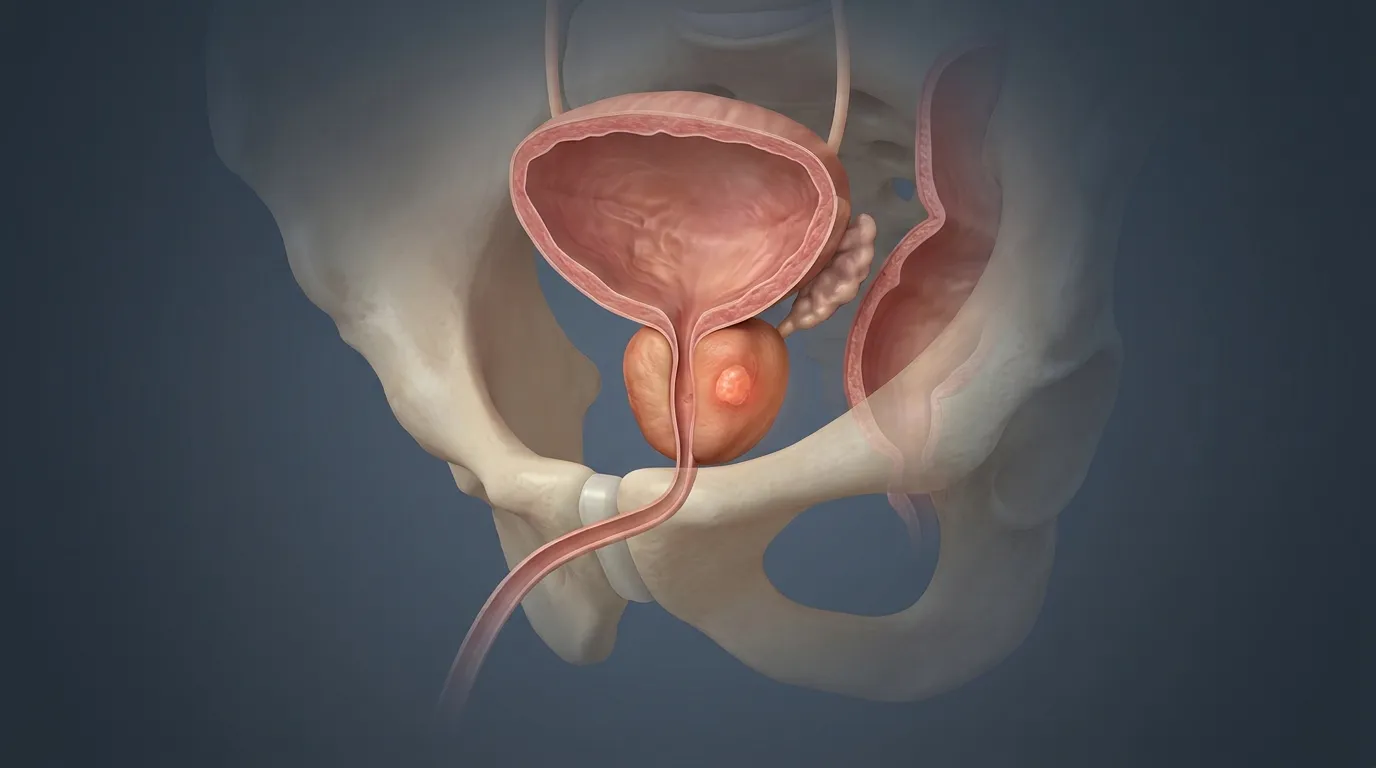
The cancer starts in the cells of the prostate, the gland below the bladder that surrounds the tube through which you pass urine. Doctors call it adenocarcinoma. These cancers do not all grow at the same speed. Many grow so slowly that they never threaten life, but others are aggressive and need prompt treatment. The diagnosis is there to tell them apart: to treat those that need it, and spare the others unnecessary treatment.
It should not be confused with benign prostate enlargement (adenoma, or BPH), a harmless growth that explains most difficulties passing urine after 50 and does not turn into cancer.
As it grows, it can cause difficulty passing urine, blood in the urine, recent erection problems or bone pain that does not go away.[3]
When to discuss a PSA test
After talking it over with a doctor, PSA testing is offered from age 50, from 45 if your father or brother had prostate cancer or if you are of sub-Saharan African origin, and from 40 if you carry a BRCA2 gene change.[1] Above 1 ng/mL at 40, or above 2 ng/mL at 60, the guideline advises repeating the test every 2 years rather than every 8. It uses these two values only to set the interval between tests. Whether you need further tests depends on the rectal examination, your PSA results and your risk factors. Read about how the diagnosis is made.
04 · The examinations
How is the diagnosis made?
Each step is done only if the one before justifies it.
Rectal examination and PSA
They point to a prostate that needs a closer look.
Prostate MRI
A scan with no X-rays shows suspicious areas and scores them from 1 to 5 (the PI-RADS score).[1]
Biopsy
Small samples, guided by the MRI, confirm the cancer and are examined under the microscope.[1] Read about MRI fusion prostate biopsy.
Staging tests, if needed
Only if the risk justifies them, tests look for cancer beyond the prostate: a CT scan, bone scan or PET scan, which can pick up cancer cells throughout the body.[1]
05 · Understanding your results
Reading the report: aggressiveness, stage and risk level
Three pieces of information in the report help decide treatment.
A
Gleason scoreISUP grade groupIn practice
6 (3 + 3)1Slow-growing cancer
7 (3 + 4)2Intermediate aggressiveness, on the favourable side
7 (4 + 3)3Intermediate aggressiveness, on the unfavourable side
84Aggressive cancer
9 or 105Very aggressive cancer
B
Stage
The TNM system describes how far the cancer extends: T for the tumour, N for the lymph nodes, M for metastases (spread to other organs). A “c” in front of the T (cT) means the stage was estimated from examination and scans. A “p” (pT) means it was measured on the removed prostate. N0 means no lymph nodes are affected.[1]
The cancer stays inside the prostate (localised cancer)
It goes beyond the outer layer of the prostate or reaches nearby organs
It has reached the lymph nodes of the pelvis
It has reached other organs, most often the bones
C
Risk levelStage (cT)Gleason score (ISUP)PSA (ng/mL)
LowT2a or less, and6 or less (ISUP 1), and10 or less
IntermediateT2b, or7 (ISUP 2 or 3), orabove 10 and up to 20
HighT2c, or8 or more (ISUP 4 or 5), orabove 20
A low-risk cancer meets all three conditions. For the other two levels, one criterion is enough.[1] For example, cT2a, Gleason 3 + 4 (ISUP 2), with a PSA of 8 is intermediate risk because of its Gleason score.
06 · Choosing a treatment
Which treatment for which cancer?
The 2023 Moroccan national guideline sets clear choices according to the risk level of a localised cancer.[1]
Low risk
Active surveillance in most cases. Surgery, radiotherapy or brachytherapy (radioactive seeds placed in the prostate) remain possible. Treatments aimed only at the diseased area are still being evaluated: focused ultrasound (HIFU), cryotherapy (freezing) and radiofrequency ablation.
Intermediate risk
Surgery (radical prostatectomy with removal of the lymph nodes) if life expectancy is more than 10 years, or radiotherapy: on its own if the cancer is on the favourable side, with short hormone therapy if it is on the unfavourable side.
High risk
Surgery as part of a combined treatment, or radiotherapy with long hormone therapy, which works better than radiotherapy alone.
If cancer has spread
Treatment is based on hormone therapy, which lowers the male hormone the cancer feeds on, sometimes combined with other medicines decided with the oncologist.[1]
Close monitoring, without immediate treatment
Many men first feel that monitoring means being left untreated. In practice, a slow-growing cancer is followed closely with PSA tests, MRI and repeat biopsies, and treated if it changes.[1] Monitoring spares many men the effects of treatment they would not have needed. Prof Ouzzane’s research showed that MRI-targeted biopsy sorts out more accurately which men can be offered this monitoring.[6]
Two recommended options for localised cancer
For a localised cancer, the guideline recommends both.[1] Surgery is usually offered to a man in good health whose life expectancy is more than 10 years. It removes the prostate and the lymph nodes. Its possible side effects are urine leakage (incontinence), which can occur but is most often temporary, and erection problems (erectile dysfunction), which depend on age, erections before the operation, the stage of the disease and whether the nerves can be spared.[1][8]
Radiotherapy is often preferred when an operation carries more risk, for example with other illnesses, or when the patient does not want surgery. For an intermediate-risk cancer on the favourable side, it can be given on its own.[1] It can irritate the bladder and rectum, but can also treat cancer that has spread to the bones.[8]
A localised cancer rarely forces an urgent decision: take the time to ask your questions.
07 · A treatment option
Radical prostatectomy
Surgical treatment
Removing the prostate and seminal vesicles
The operation removes the whole prostate and the seminal vesicles (two small glands next to it). According to the guideline, open surgery, laparoscopy (small incisions and a camera) and robot-assisted laparoscopy show no major difference in cancer control, continence or erections.[1] The studies that showed no major difference between robotic, laparoscopic and open surgery are old: they compared surgeons who were starting with the robot to surgeons with years of practice in open or laparoscopic surgery. The robot does not work on its own: it is what the robot makes possible, combined with the experience of the surgeon and the team, that gives good results.
Our published series of 132 robot-assisted prostatectomies in Casablanca gives preliminary results: the authors note that it comes from a single centre and a single surgeon, with short follow-up and no comparison group.[7] The figures, hospital stay and recovery are on our radical prostatectomy page. The robot is described on our robotic surgery page.
08 · Your care
At the practice
At the Centre d’Urologie Casablanca, we follow every step of the diagnosis: reading your PSA results and the rectal examination at consultation, prescribing and reading the MRI, and MRI fusion biopsy, at the practice or at the clinic. The biopsy results are given to you at a consultation, a few days later.
Once the diagnosis is made, we explain your risk level and possible treatments, then do the PSA follow-up after treatment. Operations take place at the Centre d’urologie Oasis in Casablanca (Akdital group, a Moroccan private hospital network), and Prof Ouzzane directs the group’s robotic surgery programme.[7][9]
09 · Travel planning
Coming from abroad
If you live outside Morocco and want an opinion or treatment in Casablanca:
- Before you travel, gather your PSA results (oldest first), MRI report and images (CD or USB key), biopsy report, any staging scans and a list of your medicines. Ask on the phone how to send them, so your case can be looked at before you arrive. You can also write to urocasa@gmail.com.
- If a biopsy or an operation is planned, ask at the consultation how long to stay in Casablanca before flying home, and how you will receive results that come after you leave.
- Before you leave, ask for the written reports: biopsy, and operation report if you had surgery.
- PSA follow-up after treatment can be done where you live and shared with a urologist there. Agree with us how your results reach us.
10 · When to seek care
When to book an appointment
Speak with a urologist if…
- your PSA rises from one test to the next
- your doctor has found something abnormal on the rectal examination
- your father or brother had prostate cancer
- you have blood in your urine, difficulty passing urine or bone pain that does not go away.[3]
Call 141 or go to the nearest emergency department if…
- you cannot pass urine at all
- you have a fever (38 °C or more) or shivering in the days after a prostate biopsy
- after an operation, a calf becomes painful or swollen, or you have chest pain or shortness of breath
- back pain comes with weakness or numbness in the legs, or loss of control of your bladder or bowels.[8]
If you have had an operation: call the practice during opening hours, or the emergency number you were given when you left the clinic. If you are outside Morocco, call your local emergency number.
11 · Your questions
Frequently asked questions
Can prostate cancer be cured?
Yes, often. For localised cancer, treatment aims for a cure and achieves it in many cases. For cancer that has spread to other organs, treatments can often control the disease, sometimes for years.
Can you die of prostate cancer?
Yes, when it is aggressive or found late. In Morocco, it is estimated to have caused 1,348 deaths in 2024.[2] Many of these cancers, though, grow slowly and do not threaten life. That is why treatment is chosen according to the risk level.
Can I live normally after treatment?
Most men treated for localised cancer return to their usual life. After surgery, urine leakage is most often temporary. Erection problems are possible after every treatment and can last. Treatments exist to help, with results that vary from one man to another.
12 · Contact
Book an appointment
Centre d’Urologie Casablanca
Request an appointment Speak with the team
22 boulevard Yacoub El Mansour, Office 42, 5th floor, Maârif, 20250 Casablanca, Morocco.
Monday to Friday, 9 am to 6 pm and Saturday, 9 am to 1 pm (Morocco time).
Telephone: +212 5 22 77 40 48
Emergency in Morocco: 141 (SAMU) or the nearest hospital emergency department.
13 · References
Sources
- 01
Moroccan national guideline (Référentiel de bonnes pratiques médicales), “Cancer de la prostate”
2023 edition, ANAM, Ministry of Health and Social Protection, National Council of the Order of Physicians, Moroccan Society of Medical Sciences. Sections II.1 (epidemiology and survival), II.3 (risk factors), III.2 (early detection), IV.1–IV.6 (diagnosis, biopsy and complications, imaging), V.2 and V.4 (Gleason score, TNM classification), VI.2, VI.3, VI.7 and VI.8 (active surveillance, prostatectomy, hormone therapy, radiotherapy), VII.1–VII.5 (treatment choice by risk).
Read the source - 02
GLOBOCAN 2024 · Morocco fact sheet
International Agency for Research on Cancer, 2024 estimates, published September 2026.
Read the source - 03
Cancer de la prostate : prévention et dépistage précoce
Moroccan Urology Association (AMU), 2024. In French.
Read the source - 04
The 2014 International Society of Urological Pathology (ISUP) Consensus Conference on Gleason Grading of Prostatic Carcinoma
Epstein JI et al. American Journal of Surgical Pathology, 2016.
Read the source - 05
Biochemical outcome after radical prostatectomy, external beam radiation therapy, or interstitial radiation therapy for clinically localized prostate cancer
D’Amico AV et al. JAMA, 1998.
Read the source - 06
Magnetic resonance imaging targeted biopsy improves selection of patients considered for active surveillance for clinically low risk prostate cancer
Ouzzane A et al. Journal of Urology, 2015.
Read the source - 07
Robot-assisted radical prostatectomy using the Toumai system: initial single-centre experience in Morocco
Et-Touzani R et al. (Prof Ouzzane, senior author). Journal of Robotic Surgery, 2026.
Read the source - 08
EAU Guidelines on Prostate Cancer
European Association of Urology, edition consulted November 2026.
Read the source - 09
Chirurgie robotique de la prostate au Maroc : quand la haute précision préserve la qualité de vie des hommes
Hespress interview with Prof Adil Ouzzane, October 2026. In French.
Read the source
This information is general and does not replace a consultation.
Appointments
Request an appointment
The practice team can call you back about your request.
Do not include symptoms, a diagnosis, or other medical information in this form.
Would you rather call? +212 5 22 77 40 48