
When can I go back to work?
Office work can usually start again after one to two weeks. For physical work, allow about a month after the operation.
Prostate surgery · Casablanca
Transurethral resection of the prostate (TURP) is for men whose prostate, 30 to 80 mL, makes passing urine difficult despite medicines. The trouble comes from an enlarged prostate (benign prostatic hyperplasia, BPH), which is not cancer. The urologist goes in through the urethra (the tube you pass urine through) and removes, in small pieces, the part that blocks the urine. Symptoms drop by about 70%, and the benefit lasts: men have been followed for up to 22 years after the operation.
Book an appointment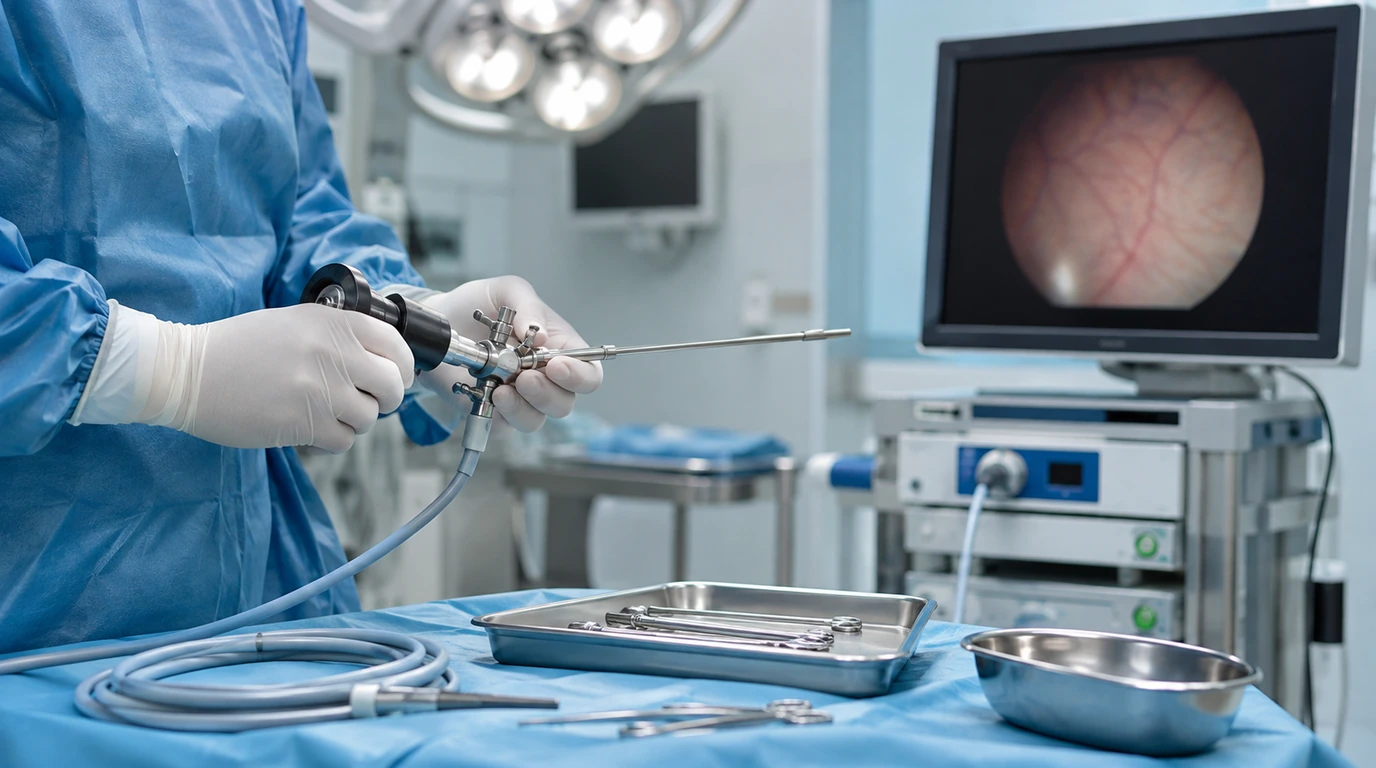
01 / KEY POINTS
| Question | Short answer |
|---|---|
| Who is it for? | An enlarged prostate of 30 to 80 mL that still bothers you despite medicines, or that is affecting the bladder or kidneys [1] |
| Result | Symptoms down by about 70%, strength of the stream more than doubled [1] |
| Catheter and hospital stay | The catheter stays until the urine is clear: a median of 24 hours, with 3 days in hospital, for men not taking a blood thinner in a study of bipolar TURP. For men on an anticoagulant: 41 hours and 4 days [1] |
| Most common side effect | Semen goes back into the bladder instead of coming out (retrograde ejaculation) |
| Need for another procedure | About 4 men in 100 at one year and 10 in 100 at five years (repeat TURP, widening of the urethra or incision of the bladder neck), in an Austrian national study of more than 41,000 men operated on by TURP [1] |
Appointments: +212 5 22 77 40 48 · Centre d’Urologie Casablanca, Maârif.
02 / WHO IT IS FOR
TURP treats an enlarged prostate, a growth that is not cancer. It is offered when medicines are no longer enough, or when the enlarged prostate is causing harm: blocked urine, infections or bladder stones, kidneys affected.
The volume of the prostate, measured on ultrasound in millilitres (mL), decides the technique. European guidelines make TURP the first choice between 30 and 80 mL [1]. Between 30 and 80 mL, either TURP or laser enucleation may be offered, depending on your situation. A smaller prostate with no middle lobe (a part of the prostate that bulges into the bladder) is better suited to a transurethral incision of the prostate (TUIP). A prostate over 80 mL points towards laser enucleation. If you take a blood thinner that cannot be stopped, European guidelines put laser vaporisation first and also list laser enucleation, for which they suggest the Thulium laser, with a weak recommendation [1]. Our page on the enlarged prostate explains this choice and how to prepare for the operation.
03 / TYPES
There are two ways of passing the current through the wire loop that cuts the prostate. With bipolar TURP, the operation is done in salt water. This removes the risk of “TUR syndrome”, a rare problem caused by the rinsing fluid being absorbed, and reduces bleeding and the time with a catheter. The results on urinary symptoms, erections and ejaculation are the same with both techniques [1].
04 / THE OPERATION
You are asleep (general anaesthetic), or only the lower half of your body is numbed (spinal anaesthetic). The urologist passes a resectoscope through the urethra, a thin tube fitted with a camera and an electric loop, and removes the enlarged part from the inside, keeping the outer shell of the prostate. The volume of the prostate drops by 25 to 58% [1]. European guidelines note that the operation is safest when it lasts less than an hour and a half [1]. At the end of the operation, a urinary catheter rinses the bladder to prevent clots.
05 / RECOVERY
The urine is pink at first, then clears. The catheter is removed once it is clear. The stream improves as soon as the catheter comes out.
In the weeks that follow, the urge to pass urine can be sudden and burning. A little blood can come back around the third week, when the scabs fall off: drink more and it clears. For a month, avoid carrying heavy loads and long rides on a bicycle or motorbike, and avoid constipation, which makes you strain.
The tissue removed is sent to the laboratory, like any tissue taken out during an operation. We go through the result with you at the follow-up consultation.
06 / SIDE EFFECTS AND RISKS
The most common effect is retrograde ejaculation: after the resection, semen no longer comes out and goes back into the bladder. It is not dangerous and the pleasure remains, but a natural pregnancy becomes difficult. If you still want children, talk to us before the operation (see also the enlarged prostate page).
The other risks, from an analysis of published trials of monopolar TURP [1]:
| Risk | Average frequency |
|---|---|
| Clots that block the catheter | About 5 men in 100 |
| Blocked urine after the catheter is removed | About 4 to 5 in 100 |
| Urinary infection | About 4 in 100 |
| Bleeding that needs a transfusion | About 2 in 100 |
| TUR syndrome (monopolar only) | Fewer than 1 in 100 |
If you take a blood thinner and keep taking it, the bipolar TURP study cited by European guidelines gives these figures [1] [2]. Men on aspirin had results similar to men on no blood thinner. Men on clopidogrel, another antiplatelet medicine (one that stops the small blood cells called platelets from clumping together), more often needed a transfusion, 19 in 100 against 1 in 100, and more often had to come back into hospital, 19 in 100 against 3 in 100. This group was small: 16 men [2]. Whether to stop the medicine before the operation is decided with the doctor who prescribed it.
Later, a narrowing of the urethra or of the bladder neck can weaken the stream again. Urine leakage and erection problems are also among the long-term complications described, without the studies giving how often they happen [1].
07 / URGENT CARE
In Morocco, call 141 (SAMU, the emergency medical service) or go to the nearest emergency department if:
If you are outside Morocco, call your local emergency number.
If you have had an operation: call the practice during opening hours, or the emergency number you were given when you left the clinic.
08 / AT THE PRACTICE
At our practice in Maârif, we carry out the assessment before the operation: consultation, urine flow test (which measures the strength of your stream), ultrasound of the prostate and, if needed, a urodynamic test (which measures the pressure in the bladder while it fills and empties). The details are on the enlarged prostate page. The resection takes place at the Centre d’urologie Oasis in Casablanca (Akdital, a Moroccan private hospital network). We see you again after the operation with the laboratory result.
09 / TRAVEL
If you live outside Morocco and plan your TURP in Casablanca:
10 / QUESTIONS
Office work can usually start again after one to two weeks. For physical work, allow about a month after the operation.
Erection problems after surgery for an enlarged prostate remain very rare, even exceptional. Studies find no difference in erections between monopolar and bipolar TURP, nor between TURP and laser enucleation in the short and medium term. Erection problems are still listed among the long-term complications [1].
11 / APPOINTMENTS
Centre d’Urologie Casablanca, practice of Prof Adil Ouzzane and Dr Alae Touzani, 22 boulevard Yacoub El Mansour, Office 42, 5th floor, Maârif, 20250 Casablanca, Morocco.
Telephone: +212 5 22 77 40 48, Monday to Friday 9 am to 6 pm and Saturday 9 am to 1 pm (Morocco time). Request an appointment online.
12 / REFERENCES
March 2026 update. Sections 5.3.1.a (monopolar and bipolar TURP: results, follow-up of 8 to 22 years, another procedure in 3.7% at one year and 9.5% at five years, of which repeat TURP 2.4% and 6.1%, complications, bipolar TURP study: median catheter time 24 hours and hospital stay 3 days in patients not on anticoagulants, 41 hours and 4 days under oral anticoagulation, under antiplatelet therapy, blood transfusion 19% vs 1% and rehospitalisation 19% vs 3%, outcomes under aspirin comparable to controls), 5.3.2.c (Holmium laser enucleation: erection), 5.3.2.d (Thulium laser enucleation for patients on anticoagulant or antiplatelet therapy, weak recommendation), 5.3.3.b (laser vaporisation for these patients), figure 4 (treatment flowchart: men who cannot stop anticoagulant or antiplatelet therapy, laser vaporisation as first choice, laser enucleation). There is currently no Moroccan guideline on enlarged prostate.
Read the EAU guidelinesJ Endourol, 2019 (the study cited by the EAU, reference 357: 130 men on aspirin, 16 on clopidogrel, 57 on anticoagulant, 73 on no blood thinner).
Read the paperThis information is general and does not replace a consultation.
Appointments
The practice team can call you back about your request.
Do not include symptoms, a diagnosis, or other medical information in this form.
Would you rather call? +212 5 22 77 40 48