
Kidney surgery · Casablanca
Partial nephrectomy: removing a kidney cancer and keeping the kidney
Partial nephrectomy removes the kidney tumour with a margin of healthy tissue and keeps the rest of the kidney. The choice of operation depends on the tumour, your kidney function and what can be done safely.
Book an appointment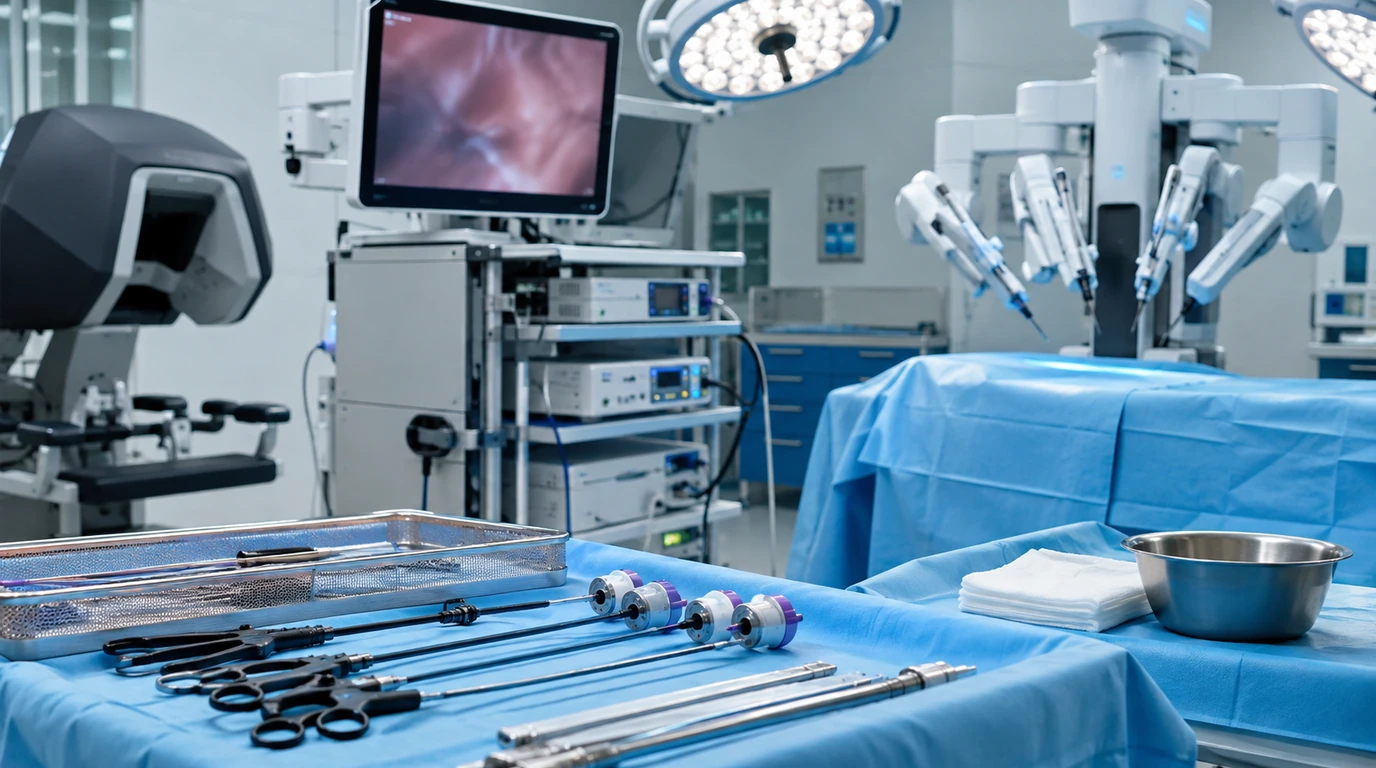
01 / KEY POINTS
Key points
A partial nephrectomy removes a kidney tumour with a margin of healthy tissue and keeps the rest of the kidney. For a tumour of 7 cm or less that is confined to the kidney, European guidelines advise this operation whenever it is technically possible: cancer control is the same as removing the whole kidney, and the operated kidney goes on filtering the blood [1]. We perform it at the Centre d’urologie Oasis in Casablanca (Akdital group, a Moroccan private hospital network) [3], most often with the robot, and very rarely as open surgery.
Appointments: +212 5 22 77 40 48 · Centre d’Urologie Casablanca, Maârif.
02 / DIAGNOSIS
A kidney mass is not always a cancer
About 15 in 100 removed kidney tumours turn out to be benign once analysed in the laboratory [1]. A CT or MRI scan often recognises one of them, the angiomyolipoma, by the fat it contains. Another, the oncocytoma, can only be told apart from a cancer in the laboratory [1].
A biopsy, a needle sample taken through the skin, can show what the tumour is before deciding. In a study of 542 removed tumours, centres that used it operated on fewer benign tumours: 5 in 100 instead of 16 in 100 [1]. It cannot confirm an oncocytoma, which one type of cancer imitates under the microscope. It is mostly useful if watching the tumour, or destroying it without removing it, is being considered, and it is required before destroying a tumour [1].
03 / THE OPERATION
What happens during the operation
You are asleep (general anaesthetic). With the robot, the surgeon passes the instruments through a few small cuts in the abdomen or side. In open surgery, there is a single, larger cut. In both cases, the surgeon finds the tumour, removes it with a margin of healthy kidney, then closes the kidney with stitches.
To limit bleeding, the surgeon usually closes the kidney’s artery while removing the tumour. The kidney tolerates this short stop. Operating without closing the artery does not improve the function of a normal kidney, and the guidelines keep it for specific cases, such as a single kidney [1]. A drain, a small tube coming out through the skin, is not always placed: placing one or not does not change recovery [1].
The removed tumour goes to the laboratory, which says whether it is a cancer and checks the edge of the removed tissue, called the margin. In 2 to 8 in 100 patients operated on for a tumour of 7 cm or less, tumour cells touch this edge: this is a positive margin [1]. In that case, the guidelines advise closer scans, not a new operation or removal of the kidney. The tumour comes back in only a minority of these patients, about 16 in 100 [1].
04 / RECOVERY
How long in hospital, and recovery
With the robot, the hospital stay is shorter than after open surgery, with less pain and fewer strong painkillers (opioids) during the first month [1]. As a guide, in the United Kingdom, Cancer Research UK says people may go home 1 to 2 days after keyhole surgery, or 3 to 4 days after open surgery [5]. The urinary catheter is usually removed when your urine is clear, no later than the next day. A drain, if there is one, stays until it stops draining fluid [5]. Moving about early helps you recover faster [5]. Your expected stay and return-to-work date are given at the consultation before the operation.
In Morocco, call 141 (SAMU, the emergency medical service) or go to the nearest emergency department if, after the operation:
- you have a fever (38 °C or more) or shivering
- you cannot pass urine
- you are bleeding heavily, with clots in your urine
- you have pain on the operated side or in the abdomen that gets worse, or vomiting
- fluid leaks from a wound
- a calf becomes painful and swollen, or you are short of breath.
If you are back home outside Morocco, call your local emergency number (for example, 999 or 112 in the UK, 112 in the European Union, 911 in the US and Canada, 998 in the UAE, 997 in Saudi Arabia), then let us know.
If you have had an operation: call the practice during opening hours, or the emergency number you were given when you left the clinic.
05 / FOLLOW-UP
Life after the operation
After you go home, a consultation goes through the laboratory result with you. Follow-up then includes scans and a blood test for kidney function, at intervals set according to that result.
The kidney you keep goes on filtering the blood. Kidney function is better preserved than after removing the whole kidney, which may lower the risk of one day needing dialysis [1]. This matters even more if you have diabetes, high blood pressure or a single kidney, situations where every working part of a kidney helps.
When it is a cancer that has not spread to other organs, about 81 to 91 in 100 people are alive five years later, depending on the type of cancer the laboratory finds, but the figure is lower for a rare type, collecting duct cancer (44 in 100) [1]. These figures also count deaths from other illnesses. They come from studies cited by the European guidelines. There is no published Moroccan figure. In Morocco, GLOBOCAN estimates 518 new kidney cancers in 2024 [2].
06 / CHOOSING AN OPERATION
Partial or radical nephrectomy?
A radical nephrectomy removes the whole kidney with the tumour. The 2026 European Association of Urology (EAU) guidelines strongly advise a partial nephrectomy for a tumour of 7 cm or less that is confined to the kidney. For a larger tumour, it is mainly considered if you have only one kidney or if your kidneys already work less well (chronic kidney disease) [1].
We advise a partial nephrectomy when the tumour measures 7 cm or less and its position allows it to be removed on its own. That holds even if it means open surgery: if the kidney can be kept, it is better to keep it with an open operation than to remove the whole kidney with the robot, and the guidelines say so strongly [1]. We suggest a radical nephrectomy when the tumour is too large, too central or involves the kidney’s main blood vessels.
If you are frail, with several other illnesses, the decision is made case by case: a partial nephrectomy gives slightly more complications than a radical one, but the radical one harms kidney function more [1].
07 / SURGICAL APPROACH
Robot or open surgery?
Robotic surgery and open surgery have been compared in trials that assigned each patient’s technique at random. The largest was in tumours that were hard to remove. In the month after the operation, a little more than one in three patients operated on with the robot had at least one complication (37 in 100), against nearly one in two with open surgery (46 in 100). These figures apply to complex tumours, not to all kidney tumours, and the gap is not clear enough to conclude that the robot causes fewer complications [1]. The trial stopped early, with 240 of the 606 patients planned [4].
With the robot, the operation takes a little longer, but the stay is shorter, pain is lower and quality of life is better during the first month [1]. A small trial and a large series outside trials found less bleeding or fewer complications with the robot, with the same kidney function [1].
Names of the studies, for your doctor: OpERA, ROBOCOP II, IRON-I and CLOCK [1] [4].
08 / RISKS
What are the risks?
In the largest trial, the two most frequent serious complications in the month after surgery, meaning those that need a new procedure or a stay in intensive care, were a urine leak where the kidney was stitched and bleeding [1] [4]. The leak affected about 4 in 100 patients with the robot and 2 in 100 with open surgery. Bleeding, about 2 in 100 with the robot and 1 in 100 with open surgery. Both complications were therefore slightly more frequent with the robot, on very small numbers of patients [1] [4].
The other risks are those of any surgery: infection, a blood clot in a leg vein, and effects of the anaesthetic.
The guidelines note that hospitals that perform many partial nephrectomies may have fewer complications and better margins [1]. Our team’s number of operations is not yet published.
09 / OTHER OPTIONS
Are there other treatments?
For a small tumour, there are two other options. The first destroys the tumour without removing it, with heat (radiofrequency) or cold (cryotherapy), using a needle passed through the skin, after a biopsy. The second is active surveillance: regular scans for a tumour of 4 cm or less that does not need treatment straight away [1].
In one series of 308 patients treated by cold, the tumour came back in place for about 35 in 100 tumours larger than 4 cm, against about 8 in 100 for smaller ones [1]. The guidelines do not routinely offer destruction above 3 cm with heat or above 4 cm with cold [1].
If you can have surgery, a partial nephrectomy is the first choice. Destruction is considered if you need treatment but surgery carries too much risk for you, and the tumour stays under these sizes. Surveillance suits a tumour of 4 cm or less when treatment can wait, for example in an older person or someone with other serious illnesses [1].
10 / INTERNATIONAL PATIENTS
Coming from abroad
If you live outside Morocco and plan your operation in Casablanca:
- Before you travel, send or bring your CT or MRI scan (report and images on CD or USB key), your latest blood tests and a list of your medicines, so your case can be prepared before you arrive.
- Plan your stay around the hospital stay given at the consultation, and ask then how long to stay in Casablanca before flying home.
- Before you leave hospital, ask when you can go back to your normal activities, including driving, and how long you need to keep having injections against blood clots once you are home [5].
- The laboratory result is gone through at a consultation after you leave hospital: ask how you will receive it if you have already flown home, and ask for your operation report before you leave. Follow-up scans and blood tests can then be shared with a urologist where you live.
11 / AT THE PRACTICE
Your assessment before the operation
At the Centre d’Urologie Casablanca, we go through your CT or MRI scan and your kidney function with you before suggesting an option. Bring your scans to the consultation (report and images on CD or USB key) and your latest blood tests.
12 / APPOINTMENTS
Book an appointment
Centre d’Urologie Casablanca, 22 boulevard Yacoub El Mansour, Office 42, 5th floor, Maârif, 20250 Casablanca, Morocco.
Telephone: +212 5 22 77 40 48, Monday to Friday 9 am to 6 pm and Saturday 9 am to 1 pm (Morocco time). Request an appointment online.
Emergency in Morocco: 141 (SAMU) or the nearest hospital emergency department. Outside Morocco, call your local emergency number. If you have had an operation: call the practice during opening hours, or the emergency number you were given when you left the clinic.
13 / SOURCES
Sources
- 01
European Association of Urology (EAU), Guidelines on Renal Cell Carcinoma
March 2026 update. Sections 3.4 (five-year survival: 91% chromophobe, 82% papillary, 81% clear cell, 44% collecting duct), 3.5 and 3.6 (benign tumours), 5.3 (biopsy, 542 small kidney tumours removed), 7.2.2 (indications, strong recommendation for T1 tumours), 7.2.3.b.2 (OpERA, ROBOCOP II and IRON-I, in OpERA, complications in the first month in 37% with the robot and 46% with open surgery, urine leak 4/112 against 2/89, bleeding 2/117 against 1/89), 7.2.3.b.9 (CLOCK trial, clamping), 7.2.3.c (positive margins), 7.2.3.d (drain, hospital volume, no minimally invasive radical nephrectomy when a partial one is feasible), and 7.2.4 (ablation, in a series of 308 patients treated by cold: local recurrence 7.7% for tumours of 4 cm or less, 34.5% above, active surveillance). There is currently no Moroccan guideline on kidney cancer.
View EAU guidelines - 02
International Agency for Research on Cancer, GLOBOCAN 2024
Morocco fact sheet (kidney cancer: 518 new cases).
View Morocco fact sheet - 03
Centre d’Urologie Casablanca, current profile of Prof Adil Ouzzane
Specialties include robot-assisted surgery for kidney and adrenal gland cancer.
View profile - 04
Grimm et al., “Open versus robotic-assisted partial nephrectomy in patients with intermediate/high-complexity kidney tumours: final results of the randomised, controlled, open-label, multicentre trial OpERA”
Annals of Oncology, 2025 (240 patients randomised of 606 planned, 117 operated on with the robot and 90 with open surgery after withdrawals, complications assessable at one month in 112 and 89).
Read the article - 05
Cancer Research UK, “After kidney cancer surgery”
Last reviewed 11 January 2024 (practical information).
Read after-surgery information
This information is general and does not replace a consultation.
Appointments
Request an appointment
The practice team can call you back about your request.
Do not include symptoms, a diagnosis, or other medical information in this form.
Would you rather call? +212 5 22 77 40 48