
Who it is for
A raised or rising PSA, an abnormal rectal examination, a suspicious area on MRI
Source [1]
Urology · Casablanca
At the practice, a prostate biopsy is done under local anaesthetic and takes about half an hour. At the clinic, it is a day-case procedure under regional or general anaesthetic; plan to spend a few hours there. In both settings, the samples target the suspicious area seen on MRI using image fusion. A biopsy does not mean you have cancer: it is how cancer is looked for. It is the only test that can confirm cancer, and a normal result does not always rule one out.
01 · Key information
At the practice, prostate biopsy is done under local anaesthetic and takes about half an hour. At the clinic, it is a day-case procedure under regional or general anaesthetic; plan to spend a few hours there. In both settings, the samples target the suspicious area seen on MRI using image fusion. A biopsy does not mean cancer: it looks for it. It is the only test that can confirm cancer, and a normal result does not always rule it out.
Appointments: +212 5 22 77 40 48 · Centre d’Urologie Casablanca, Maârif district.
02 · Quick guide
A raised or rising PSA, an abnormal rectal examination, a suspicious area on MRI
Prostate MRI, nothing to eat beforehand, a small enema, one dose of antibiotic for a biopsy at the practice
At the practice: local anaesthetic; at the clinic: regional or general anaesthetic. Several targeted samples.
Home the same day; results at a consultation a few days later
Infection mainly associated with the transrectal route: about 5 men in 100, 3 of them with fever
03 · From suspicion to diagnosis
PSA (a protein measured in the blood) and a rectal examination (the doctor feels the prostate with a gloved finger) can raise suspicion of cancer without proving it. Only examining a piece of prostate tissue under a microscope can tell. The doctor who examines it is called a pathologist.
The 2023 Moroccan guideline recommends a prostate MRI before a first biopsy when the risk is judged intermediate or high.[1] MRI scores each suspicious area from 1 (very unlikely to be cancer) to 5 (very likely): this is the PI-RADS score. A score of 3, 4 or 5 strongly supports biopsy, with samples aimed at that area.[1] If the MRI is reassuring (score 1 or 2), the doctor looks at PSA density, the PSA divided by prostate volume. Below 0.15, fewer than 7 men in 100 have a significant cancer, so biopsy can be postponed after discussion.[1] If suspicion remains high despite a normal MRI, a standard biopsy is still advised.[1]
If your PSA result worries you, our prostate cancer page explains how it is interpreted.
04 · Targeting the sample
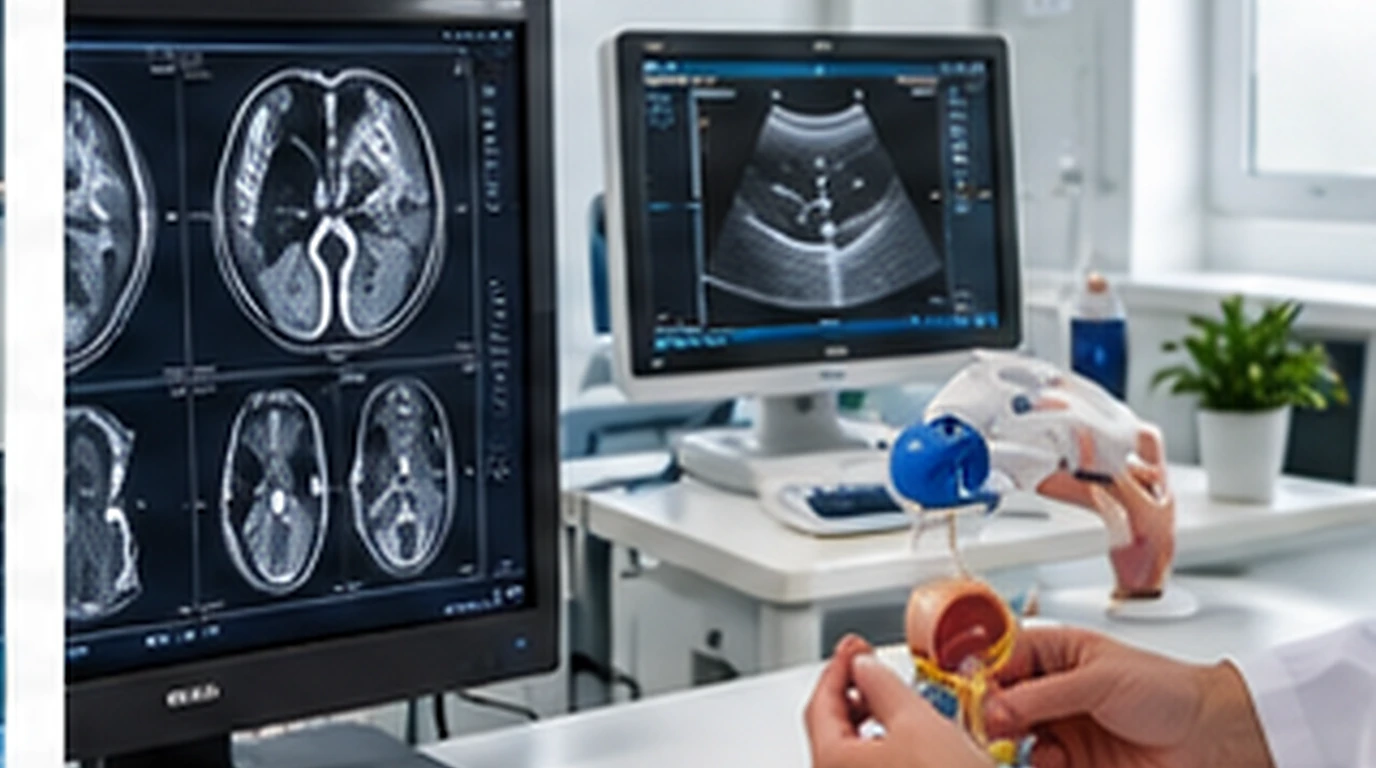
MRI fusion biopsy is also called MRI-guided or targeted biopsy. During the test, the urologist guides the needle with an ultrasound probe. Ultrasound alone shows cancers poorly. Fusion overlays your MRI images, loaded from the radiologist’s CD, onto the live ultrasound image. Software tracks the probe and displays the MRI target on the ultrasound image, so the urologist can see where the needle will go.[3]
At the practice we use the Virtual Navigator system made by Esaote.[3] The guideline recommends sampling the target and the area around it, as well as taking samples across the whole prostate in a fixed pattern.[1]
05 · The approach
At the practice, samples pass through the rectum to reach the prostate: this is the route used for biopsies at the practice.
At the clinic, samples pass through the skin between the scrotum and the anus: this is the transperineal route. It was developed to reduce infections after biopsy.[1]
We discuss the route with you before the test, based on your prostate, the target’s position and your medical history, and explain why.
06 · Before your visit
In this order:
Tell us about any blood-thinning medicines. Low-dose aspirin can usually be continued. Other medicines, such as clopidogrel (Plavix), ticagrelor (Brilique), rivaroxaban (Xarelto), dabigatran (Pradaxa) or acenocoumarol (Sintrom), are stopped or replaced only on the advice of the doctor who prescribed them.[1]
At home, use the small rectal enema prescribed to empty the rectum.[2]
The Moroccan Urology Association patient leaflet asks you to fast. We confirm the instructions when you book.[2]
Bring: your MRI CD and report, your latest PSA results and a list of your medicines.
07 · During your visit
You lie on your side or your back. The ultrasound probe is put in place, then the urologist injects local anaesthetic around the prostate. The guideline recommends this because gel alone relieves pain less well.[1] The injection and sampling can cause discomfort or mild pain.[2] Each sample comes with a small sharp click.
The urologist takes several samples, targeted using the MRI.[2] Allow about half an hour at the practice in total.[2][3] At the clinic, the biopsy is a day-case procedure: plan to spend a few hours there, for arrival, preparation, the biopsy, a short period of monitoring and discharge.
08 · Once you are home
You go home once you can pass urine normally.[3]
You may see a little blood in your urine or stools. Avoid sex and strenuous exercise for a few days.[2]
The samples are examined in the pathology laboratory. We give you the result at a consultation.[3]
Semen may stay blood-stained for several weeks. This is harmless.[2]
09 · When to seek help
The transrectal route is mainly associated with urinary infection: according to the Moroccan guideline, about 5 men in 100 are affected, 3 of them with fever.[1] For a transperineal biopsy at the clinic, the risk of infection is close to zero. Infection after a transrectal biopsy is treated with antibiotics in hospital. Less often, the prostate, bladder or rectum may bleed.
In Morocco, call 141 (SAMU) or go to the nearest emergency department in the days after the test if:
If you have had an operation: call the practice during opening hours, or the emergency number you were given when you left the clinic.
10 · Travel planning
If you live outside Morocco and plan your biopsy in Casablanca:
If possible, have your prostate MRI before you travel and bring the CD and report. When you book, we check that it can be used for fusion.
Bring your latest PSA results and a list of your medicines. Tell us about blood thinners when booking, as some may need to be stopped or replaced on your doctor’s advice.
The test takes about half an hour and you go home the same day. Results are given at a consultation a few days later. Ask when booking how you will receive them if you have already left Morocco.
11 · At the Centre
At the Centre d’Urologie Casablanca, we perform MRI fusion biopsy at the practice or at the clinic, then see you again to discuss the result and next steps. We target the area seen on MRI, including the front of the prostate, which a standard biopsy reaches poorly. Research by Prof Ouzzane’s team at Lille University Hospital on MRI combined with targeted biopsies showed this gap.[4]
Targeted biopsy also helps identify men who may be suitable for monitoring rather than treatment.[5] Prof Ouzzane was first author of the 2011 French recommendations on prostate biopsy[6] and a member of the French National Authority for Health working group on targeted biopsies in 2023.[7]
12 · Your questions
A second set of biopsies may be offered, especially if PSA density (PSA divided by prostate volume) is above 0.15 or if PSA is rising quickly. An MRI is strongly recommended before this second series if you have not had one yet.[1]
When a prostatectomy is decided, it may take place a few days to a few weeks after the biopsy, depending on your situation. Our radical prostatectomy page describes the operation.
13 · References
2023 edition, ANAM, Ministry of Health and Social Protection, National Council of the Order of Physicians, Moroccan Society of Medical Sciences. Sections IV.4.a–IV.4.m (biopsy work-up, antibiotic prophylaxis, anaesthesia, targeted biopsy, complications and transperineal route) and VI.3 (interval before prostatectomy). In French.
View sourcePatient information leaflet, in French.
View sourceCurrent practice page, in French.
View sourceOuzzane A et al. Urology, 2011.
View sourceOuzzane A et al. Journal of Urology, 2015.
View sourceOuzzane A et al. Progrès en Urologie, 2011. In French.
View sourceHaute Autorité de Santé, evaluation report, December 2023 (working group list). In French.
View sourceThis information is general and does not replace a consultation.
Appointments
The practice team can call you back about your request.
Do not include symptoms, a diagnosis, or other medical information in this form.
Would you rather call? +212 5 22 77 40 48