
Urology · Women’s health · Casablanca
Sacrocolpopexy: repairing a pelvic organ prolapse, most often with the robot
Sacrocolpopexy, called promontofixation in French, is an operation for a pelvic organ prolapse, when organs slip down into the vagina. The UK guideline offers it with mesh for a prolapse of the top of the vagina after the womb (uterus) has been removed, and a similar operation for a prolapse of the womb. For the bladder or the rectum slipping down, it advises a repair through the vagina without mesh [4]. At the clinic, the surgeon most often operates with the robot, more rarely by laparoscopy: in both cases through a few small cuts in the abdomen, with a camera. The vagina is lifted and fixed higher up with a strip of synthetic mesh, a soft material that stays in place for good.
Book an appointment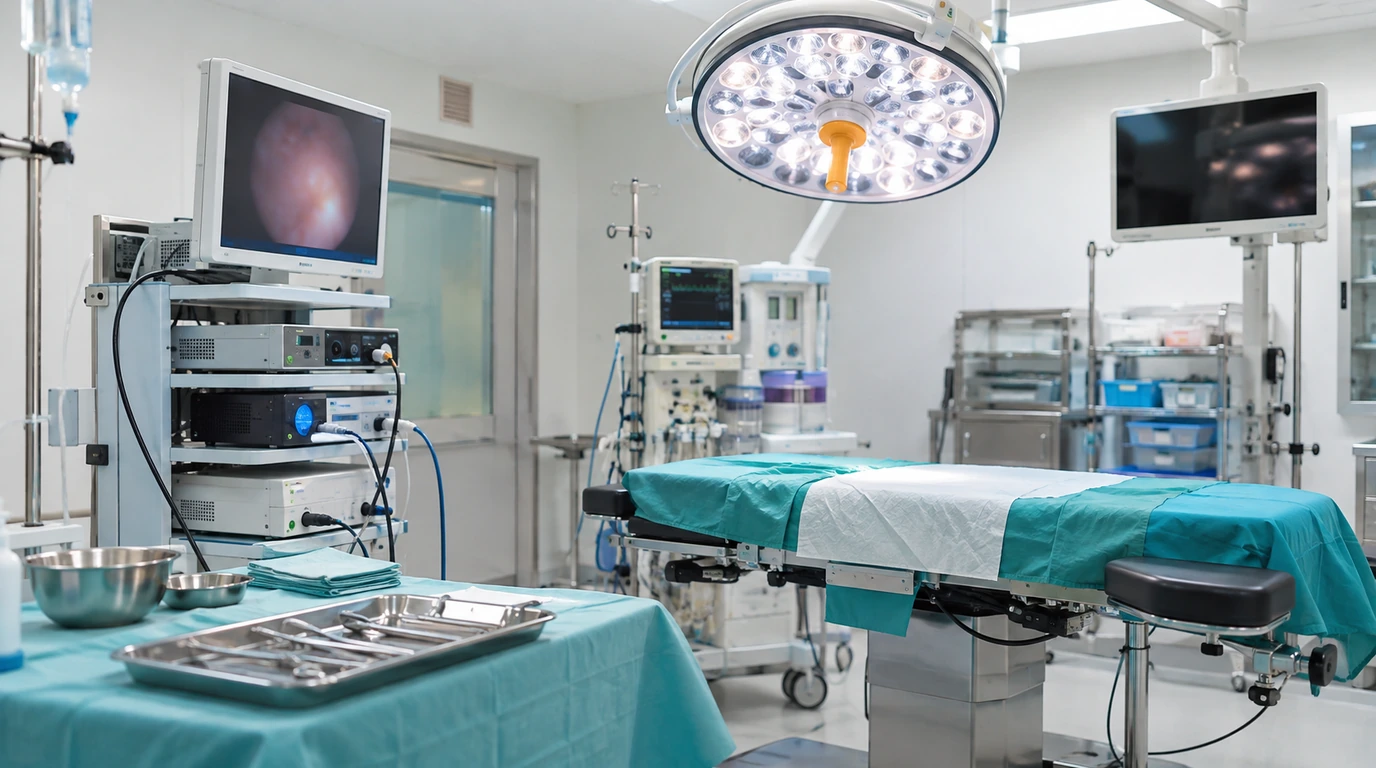
Appointments: +212 5 22 77 40 48, Centre d’Urologie Casablanca, Maârif.
Before and after the operation, you are seen at the practice by our urologists, who examine you there. You are welcome to bring someone with you to every consultation.
| Question | Answer |
|---|---|
| What it treats | Prolapse of all three compartments: the bladder at the front (cystocele), the womb in the middle (uterine prolapse), the rectum at the back (rectocele) (see Who it is for). |
| What it does not treat on its own | Leaking on effort (stress urinary incontinence), which is corrected by a mid-urethral sling, sometimes during the same operation after discussion: operating on both together increases the risk of side effects. [3] |
| Anaesthetic | General (you are asleep) |
| Hospital stay | A few days, to be confirmed at the consultation. |
01 / WHO IT SUITS
Who it is for
The UK guideline (NICE, 2019) sets out which operation to offer for which prolapse [4]:
| Prolapse | What NICE advises [4] |
|---|---|
| Top of the vagina (vault), after the womb has been removed | A choice between sacrocolpopexy with mesh and a repair through the vagina with stitches |
| Womb (uterus) | Repairs through the vagina with stitches, with or without removing the womb, or a similar operation with mesh that keeps the womb (sacrohysteropexy) |
| Front wall of the vagina (the bladder) | A repair through the vagina without mesh |
| Back wall of the vagina (the rectum) | A repair through the vagina without mesh |
At the clinic, we perform sacrocolpopexy for prolapse of all three compartments: the bladder, the womb and the rectum. A repair through the vagina is also done, in rarer cases: a very elderly woman, or a woman who cannot have a general anaesthetic, because it can be done under spinal anaesthesia (numbing of the lower body).
The European guidelines on women’s urinary problems do not say which operation suits which prolapse. They deal with the urine leaks that can come with a prolapse and its repair. [3]
Whatever the prolapse, an operation is considered for women still bothered by it after pelvic floor muscle training or a pessary (a soft ring placed in the vagina), or who do not want these treatments. [4] Sacrocolpopexy also needs a general anaesthetic. Active women who wish to keep a sex life often choose it, because it keeps the length of the vagina. All the treatments are compared on the page about pelvic organ prolapse.
02 / THE OPERATION
What the surgeon does
The surgeon separates the wall of the vagina from the bladder at the front, and from the rectum at the back when needed, and attaches the mesh to it. The other end of the mesh is attached to the promontory, the bony ridge at the top of the sacrum, the bone at the base of the spine: the mesh is fixed onto the strong ligament that covers this bone. The mesh is then covered with the thin membrane that lines the inside of the abdomen.
If the womb is healthy, it is usually kept and lifted with the vagina. It is removed only if it has a disease of its own, which is discussed before the operation.
03 / PREPARATION
Before the operation
Before deciding, we carry out the examination and urodynamic tests at the practice. These tests measure how the bladder works and look for a leak that the prolapse may be hiding. [2] A urine test checks that there is no infection. Tell us about any medicine that thins the blood (an anticoagulant, or an antiplatelet medicine such as aspirin): it sometimes has to be stopped or replaced, on the advice of the doctor who prescribed it. You see an anaesthetist before the operation.
04 / RECOVERY
After the operation, step by step
| When | What happens |
|---|---|
| The day after, or the day after that | The urinary catheter (a tube that drains the bladder) is removed. You get up from the day after the operation. |
| After a few days | You go home, on a date confirmed at the consultation. |
| The following weeks | No heavy lifting and no straining on the toilet, to let the mesh settle in. |
| Check-up consultation | The surgeon checks healing and tells you when you can have sex and do sport again. |
Pain is moderate and eased by simple painkillers. Temporary constipation is common.
05 / RISKS
Risks
Erosion is the risk specific to mesh: the mesh gradually wears through the wall of the vagina or of a nearby organ, and then has to be partly removed. The other risks are those of any abdominal surgery: infection, bleeding, injury to the bladder or bowel, which are rare.
Leaking on effort can also start after prolapse surgery in a woman who did not have it before. European guidelines ask that every patient be told about this risk. [3] For mesh, UK guidelines ask that you be told which type of mesh is used and whether it is permanent, that you be given written information on the implant (name, manufacturer, date it was put in, surgeon), and that you be offered a check-up at about 6 months with an examination to make sure there is no erosion. [4]
06 / WARNING SIGNS
Warning signs after the operation
In Morocco, call 141 (SAMU, the emergency medical service) or go to the nearest emergency department if:
- you have a fever of 38 °C or more, or shivering
- you have abdominal pain that gets worse, a swollen abdomen or vomiting
- you cannot pass urine, or you have heavy bleeding with clots
- you have a painful or swollen calf, chest pain or sudden breathlessness (possible signs of a blood clot), including during or after the flight home.
If you are outside Morocco, call your local emergency number.
If you have had an operation: call the practice during opening hours, or the emergency number you were given when you left the clinic.
07 / TRAVEL
Coming from abroad
If you live outside Morocco and plan your operation in Casablanca:
- To get in touch in writing, e-mail the practice at urocasa@gmail.com.
- Before you travel, send or bring your ultrasound reports, any earlier test results and a list of your medicines, including any blood thinner.
- Plan your stay around the hospital stay given at the consultation, and ask then how long to stay in Casablanca before flying home.
- Before you leave, ask for your operation report and for the written information on the mesh (name, manufacturer, date it was put in, surgeon) that UK guidelines recommend. [4]
- Follow-up, including the check-up at about 6 months, [4] can be shared with a urologist where you live.
08 / AT THE PRACTICE
At the practice
At the practice, we carry out the examination, urodynamic tests and follow-up on site. The team includes Dr Alae Touzani, who holds a diploma from Paris in pelvic floor problems such as prolapse and urine leaks. [1] The operation itself takes place in a private hospital.
09 / APPOINTMENTS
Booking an appointment
Centre d’Urologie Casablanca, practice of Prof Adil Ouzzane and Dr Alae Touzani, 22 boulevard Yacoub El Mansour, Office 42, 5th floor, Maârif, 20250 Casablanca, Morocco.
Telephone: +212 5 22 77 40 48, Monday to Friday 9 am to 6 pm and Saturday 9 am to 1 pm (Morocco time). Request an appointment online.
10 / REFERENCES
Sources
- 01
Centre d’Urologie Casablanca, current profile page of Dr Alae Touzani
Diploma “Pelvi-périnéologie et statique pelvienne”, Paris, on pelvic floor disorders and prolapse. Training in robotic and minimally invasive surgery. In French.
View profile - 02
Centre d’Urologie Casablanca, current home page
Urodynamic tests carried out at the practice. In French.
Visit the practice website - 03
European Association of Urology (EAU), Pocket Guidelines, Non-neurogenic Female LUTS, 2026
Combined prolapse and incontinence surgery: higher risk of side effects, to be discussed beforehand. Inform every patient of the risk of new stress incontinence after prolapse surgery, strong recommendation. The pocket does not set which operation suits which prolapse.
Read the EAU guidelines - 04
National Institute for Health and Care Excellence (NICE, UK). Urinary incontinence and pelvic organ prolapse in women: management (NG123)
2019, recommendations 1.8.1 (surgery when symptoms have not improved, or the woman has declined, non-surgical treatment), 1.8.6 (information on mesh), 1.8.10 and 1.8.11 (uterine prolapse: repairs with sutures, or sacrohysteropexy with mesh), 1.8.16 (vault prolapse: sacrospinous fixation with sutures or sacrocolpopexy with mesh), 1.8.20 (anterior repair without mesh), 1.8.23 (posterior repair without mesh) and 1.8.24 (check-up at 6 months). In English.
Read NICE recommendations
This information is general and does not replace a consultation.
Appointments
Request an appointment
The practice team can call you back about your request.
Do not include symptoms, a diagnosis, or other medical information in this form.
Would you rather call? +212 5 22 77 40 48