
Pelvic floor muscle training supervised by a physiotherapist, for at least three months.[2, 7]
Women’s health · Casablanca
Stress urinary incontinence in women: the mid-urethral sling (TVT/TOT)
Urine leaks that happen when you cough, laugh, sneeze or lift something are called stress urinary incontinence. Pelvic floor muscle training comes first, for at least three months. The pelvic floor is the group of muscles that closes the bottom of the pelvis. If the leaks continue, a sling placed under the urethra usually corrects them for the long term.
01 · Your care pathway
In short
Stress incontinence means urine escapes during an effort, with no warning urge. With urge incontinence, a sudden strong need to pass urine sends you rushing to the toilet, and the leak comes before you get there. The sling treats only leaking on effort. Urge leaks are treated first with bladder training, then medicines if needed.[2][7]
You can talk about this without embarrassment.Your consultation is with one of our urologists, who explains the examination before doing it. You are welcome to bring someone with you.
A mid-urethral sling, or another operation, may be discussed.[2, 7]
The effect of the sling often lasts more than ten years.[2]
Most women go home the same day or the next day.[2]
Appointments: +212 5 22 77 40 48 · Centre d’Urologie Casablanca, Maârif.
02 · Local figures
Leaking on effort in Morocco
31/100women in a Casablanca survey reported urinary leaks of any kind
13 / 100 leaks on effort
18 / 100 leaks with sudden urges
Survey of women living in Casablanca, published in 2003.[3]
Women affected were more often older, had given birth several times or had a difficult birth, or had gone through the menopause.[3]
03 · Assessment first
Tests before deciding
The examination is done with a full bladder. You are asked to cough so the doctor can see the leak and check for a prolapse, when the bladder, womb or rectum drops into the vagina.
Keep a bladder diary
For three days, note what you drink, when you pass urine and when leaks happen. European guidelines ask for at least three days. The Moroccan Urology Association has a template to download.[5]
Check for infection
A urine test rules out an infection.
Measure bladder function when needed
Urodynamic tests measure pressure in the bladder while it fills and empties. These tests can be carried out at the practice.[4]
They are used when urgency comes with the leaks, the type of leak is unclear, the bladder seems not to empty, a prolapse is present, or there has been previous surgery for leaks.[2][7]
04 · First step
Pelvic floor training first
Training is enough for some women and carries no risk. European and UK guidelines recommend supervised pelvic floor muscle training with a physiotherapist for at least three months before discussing an operation.[2][7]
3months minimum
Learn the movement, then use it in daily life
Sessions with the physiotherapist are paired with exercises at home. You learn to tighten the pelvic floor at the right moment, before effort or a cough. At the practice, we arrange this with a physiotherapist.
05 · The procedure
How the sling is fitted
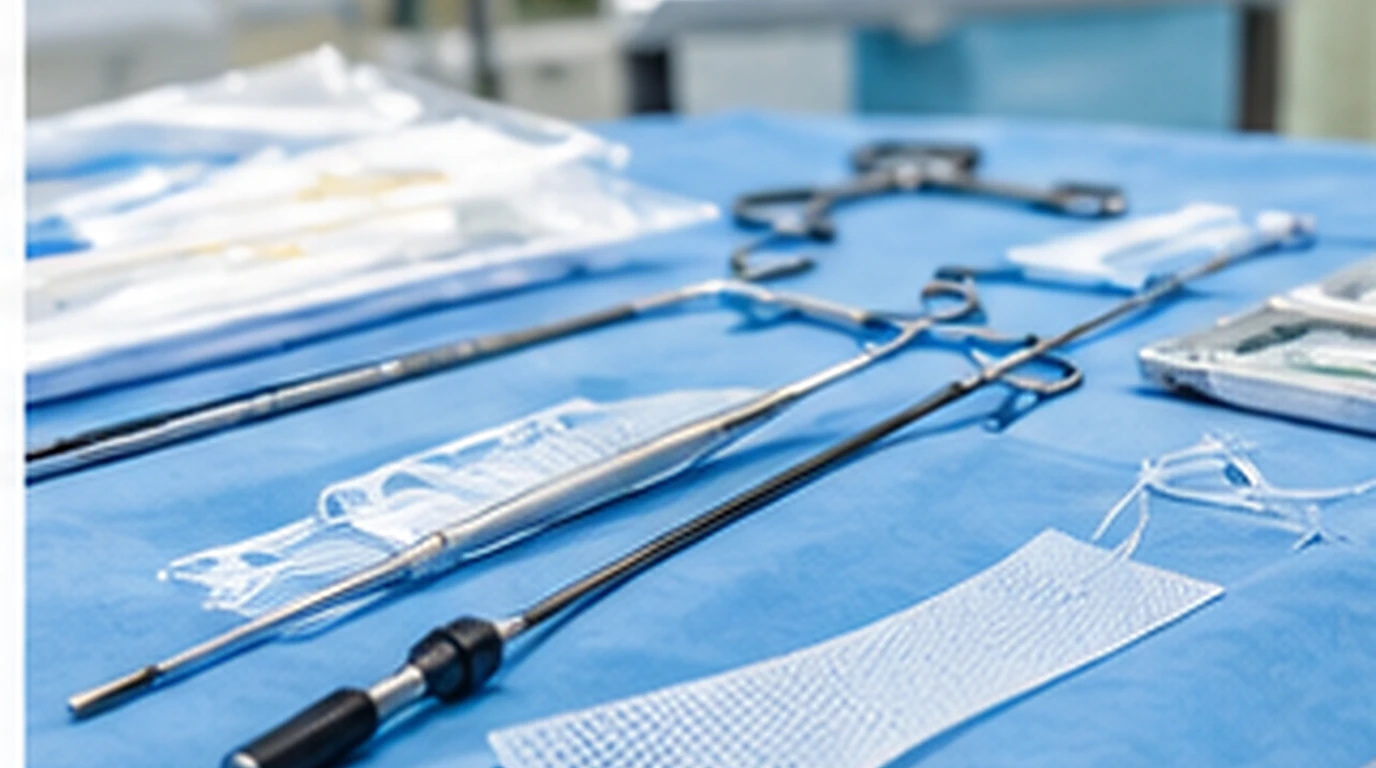
The sling is a thin strip of synthetic tape, about the width of a finger, placed under the urethra like a hammock. During an effort, it supports the urethra and holds urine in. It is put in through a small cut in the vagina and two small cuts in the skin:
Through the lower abdomen
Two small incisions just above the pubic bone create the retropubic route.
Retropubic routeThrough the groin
Two small incisions in the groin crease create the transobturator route.
Transobturator routeThe operation is short, under general or spinal anaesthetic. Most women go home the same day or the next day, once we have checked that they can pass urine normally.
06 · A shared decision
Through the lower abdomen or through the groin?
At one year, the two routes give similar results.[2] Over several years, they differ in some side effects.
07 · Making an informed choice
Risks and the mesh question
The UK decision aid gives approximate figures pooled across three operations. Except for erosion, it cannot say which operation carries more risk. “1 to 10 women in 100” means 90 to 99 women in 100 do not have that problem.[8]
Bladder injury
Usually repaired during the operation without lasting trouble. More frequent with a synthetic sling and with the route through the lower abdomen than through the groin.[2, 8]
Infection
Infection of the wound, vagina or urine during the first year.[8]
Difficulty emptying the bladder
A catheter may be needed for a few days or weeks.[8]
New sudden urges to pass urine
Some studies report up to 30 in 100 women.[8]
Lasting pain
Pain in the abdomen, pelvis or during sex. Groin pain is more frequent with the route through the groin.[2, 8]
Vaginal erosion
The synthetic sling comes through the vaginal wall. An operation may be needed to remove part of it, and complete removal is not always possible.[7, 8]
About vaginal mesh
In the United Kingdom, synthetic vaginal sling procedures have been paused since July 2018 because of long-term complications in some women. The 2026 European guidelines still describe that pause. NICE (2019) keeps the retropubic sling as an option after clear information.[6][2][7]
At our practice, we use a synthetic sling by either route. At consultation, we explain whether we can offer the option you choose or refer you to a team that does.
08 · After the procedure
Warning signs after the sling is fitted
In Morocco, call 141 (SAMU) or go to the nearest emergency department if:
- you cannot pass urine, or your bladder hardly empties any more
- you have a fever of 38 °C or more, shivering or heavy bleeding
- you have a painful or swollen calf, chest pain or sudden breathlessness, including during or after air travel.
If you have had an operation: call the practice during opening hours, or the emergency number you were given when you left the clinic.
09 · Travel planning
Coming from abroad
If you live outside Morocco and plan treatment in Casablanca:
- Contact the practice in writing at urocasa@gmail.com.
- Before you travel, send or bring your bladder diary, filled in for at least three days, any earlier test results and a list of your medicines.
- The three months of pelvic floor training come before any operation. Ask at the first consultation how it can be organised where you live.[2][7]
- If a sling is decided on, ask how long to stay in Casablanca before flying home, and ask for your operation report before you leave.
- The check-up consultation can then be shared with a urologist where you live.
10 · Your care
At the practice
Consultation · Maârif
Time for a careful assessment
Our urologists see women with urine leaks. The team includes Dr Alae Touzani, who holds a Paris diploma in pelvic floor disorders such as prolapse and urinary leaks.[1]
Tests on site
Assessment matched to your symptoms
We examine you, review your bladder diary and, when useful, carry out urodynamic tests. For your first consultation, bring your completed diary and a list of your medicines.
11 · Practical answers
Frequently asked questions
Does the sling also correct a prolapse?
No. It treats leaking on effort. A prolapse is treated separately, sometimes during the same operation after discussion. Combining the procedures increases the risk of side effects. [2] See pelvic organ prolapse and sacrocolpopexy.
When can I return to sport and lifting?
Usually after about four weeks, once the check-up consultation has taken place. Sex can usually resume after the same interval.
12 · Contact
Book an appointment
Practice of Prof Adil Ouzzane and Dr Alae Touzani
22 boulevard Yacoub El Mansour, Office 42, 5th floor, Maârif, 20250 Casablanca, Morocco.
Telephone: +212 5 22 77 40 48, Monday to Friday 9 am to 6 pm and Saturday 9 am to 1 pm (Morocco time). Request an appointment.
13 · References
Sources
- 01
Centre d’Urologie Casablanca · Dr Alae Touzani profile
Pelvic floor and prolapse qualifications and clinical practice. In French.
View source - 02
European Association of Urology · Pocket Guidelines, Non-neurogenic Female LUTS, 2026
Urodynamics, supervised pelvic floor muscle training, retropubic and transobturator slings, side effects and shared decisions. The guideline notes that synthetic slings remain paused in the United Kingdom. There is currently no Moroccan guideline on female urinary incontinence.
View source - 03
Aboutaieb R et al. · Urinary incontinence in Moroccan women: a descriptive study in an urban setting
Survey conducted in Casablanca. African Journal of Urology, 2003.
View source - 04
Centre d’Urologie Casablanca · Practice information
Urodynamic tests are carried out at the practice. In French.
View source - 05
Moroccan Urology Association · Patient information sheets
Bladder diary to download. In French.
View source - 06
UK Government · Pause on the use of vaginally inserted surgical mesh for stress urinary incontinence
Announcement, July 2018.
View source - 07
National Institute for Health and Care Excellence · NG123
Urinary incontinence and pelvic organ prolapse in women: management. Recommendations, 2019.
View source - 08
NICE · Patient decision aid for surgery for stress urinary incontinence
Complications reported in the studies reviewed for NG123, 2019.
View source
This information is general and does not replace a consultation.
Appointments
Request an appointment about stress urinary incontinence
The practice team can call you back about your request.
Do not include symptoms, a diagnosis, or other medical information in this form.
Would you rather call? +212 5 22 77 40 48