
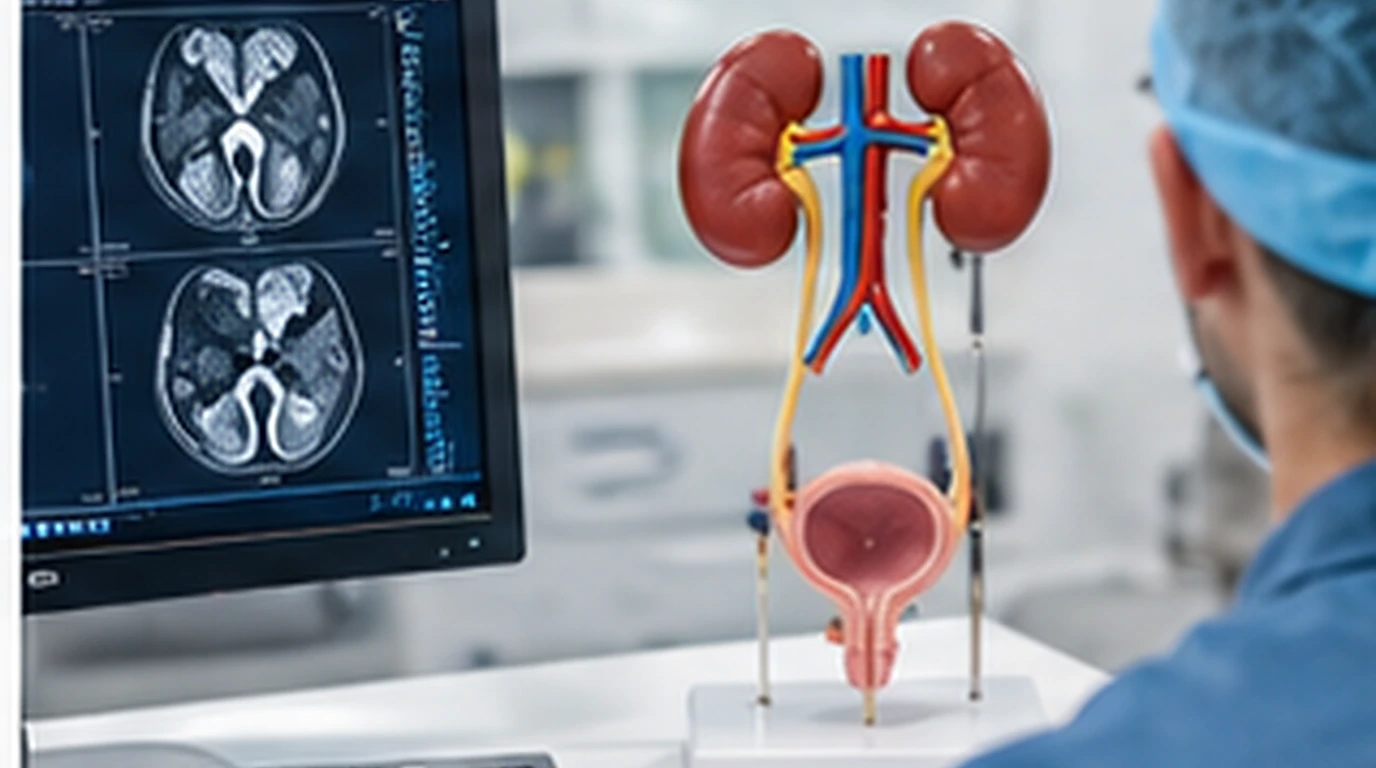
The tube that carries urine from a kidney to the bladder (one on each side).
Bladder cancer · Casablanca
Cystectomy with neobladder: replacing the bladder after cancer
A radical cystectomy removes the bladder, then replaces it with a new bladder made from a piece of bowel and joined to the urethra, the tube you pass urine through. You keep passing urine the natural way, by pushing with your abdominal muscles at set times. The operation is mainly offered when bladder cancer has grown into the bladder muscle without spreading to other organs. The other option, an ileal conduit (Bricker), drains urine into a bag on the abdomen. Both give the same result against the cancer [1].
01 · Key points
In short
A radical cystectomy with neobladder removes the bladder, then replaces it with a new bladder made from a piece of bowel and joined to the urethra, the tube you pass urine through. You keep passing urine the natural way, by pushing with your abdominal muscles at set times. The operation is mainly offered when bladder cancer has grown into the bladder muscle without spreading to other organs. The other option, an ileal conduit (Bricker), drains urine into a bag on the abdomen. Both give the same result against the cancer [1].
Appointments
+212 5 22 77 40 48 · Centre d’Urologie Casablanca, Maârif.
02 · Treatment
Who is it for, and how soon?
Cystectomy is the standard treatment for cancer that has reached the bladder muscle, with no lymph nodes involved on scans and no metastases [1]. On a medical report, this stage is written T2 to T4a, N0, M0 (T: how deep the tumour goes, N0: no lymph node involved, M0: no metastases). It is also offered for a superficial tumour that keeps coming back or does not respond to BCG (a treatment put into the bladder), cancer that has come back after radiotherapy, or to relieve bleeding and pain [1].
Your case is discussed at a multidisciplinary team meeting (urologists, oncologists, radiologists) before any decision [1]. The Moroccan guideline says not to delay cystectomy by more than 3 months after diagnosis, because this increases the risk of the cancer progressing and lowers the chances of survival, unless chemotherapy is given before surgery [1].
Chemotherapy before surgery
Cisplatin-based chemotherapy before surgery (neoadjuvant chemotherapy) means about 5 to 8 more people in 100 are alive at 5 years. It is offered to every patient who can receive it, depending on kidney function, heart and hearing [1]. The operation takes place afterwards: no trial has shown that this waiting time reduces survival [1].
The 2026 European guidelines strongly recommend adding immunotherapy before and after surgery for patients who can receive it, whether or not cisplatin is possible [2]. The Moroccan guideline, published in 2023 before these results, remains the reference in Morocco. The oncologist will tell you whether this treatment applies to you and whether you can access it.
03 · Choosing a diversion
Neobladder or ileal conduit: how to choose?
Both options should be explained to you: a choice made with full information reduces regret [1]. A neobladder suits you better if you are in good shape, motivated to learn to pass urine again and able to use a catheter: about two women in three with a neobladder need to do so [1]. An ileal conduit suits you better if a more complex reconstruction would put you at too much risk because of your other illnesses or your age [1]. Age alone does not decide: over 80, a neobladder is often not advised, without a strict limit. In centres that perform many of these operations, about 80 men and 50 women out of 100 operated on receive a neobladder [1].
When a neobladder is not possible
A neobladder is not offered [1]:
- with a neurological or psychiatric condition that prevents learning to pass urine again
- when other serious health problems make a heavier reconstruction more risky than useful
- with severe liver or kidney failure, because the bowel reabsorbs part of the urine
- when a tumour invades the urethra, or cancer is found during surgery at the cut edge of the urethra: the urethra is then removed.
It is weighed case by case after high-dose pelvic radiotherapy, with a complex narrowing of the urethra, or with heavy leakage before surgery from a weak sphincter (the muscle that holds urine in). One affected lymph node does not rule it out. Several do [1].
04 · The operation
How is a neobladder made?
Under general anaesthesia, the surgeon removes the bladder and the lymph nodes of the pelvis. In men, the surgeon also removes the prostate and seminal vesicles, two small nearby glands. In women, in the standard operation, the surgeon also removes the womb and the part of the vagina next to the bladder [1], sometimes the ovaries [5]. The urethra is kept [4].
The surgeon takes a piece from the end of the small bowel (the ileum), opens it and sews it into a reservoir. The two ureters, which carry urine from the kidneys, are joined to this reservoir, which is joined to the urethra [1]. This is a more complex reconstruction than an ileal conduit [1] [4]. In the UK, the operation takes 2 to 6 hours with a neobladder and 4 to 6 hours with an ileal conduit: the ranges overlap, and the length depends on each case [4] [7].
At the practice, we see you before and after the operation. Our urologists operate at the Centre d’urologie Oasis in Casablanca, a hospital of the Akdital group.
Two words that look alike
The single channel through which urine leaves the bladder and the body.
05 · Hospital stay
How long in hospital?
In the UK, the hospital stay usually lasts 1 to 2 weeks [4]. Ask at the consultation how long it usually is at the Centre d’urologie Oasis in Casablanca.
You eat again and get up in the first few days: this enhanced recovery means the bowel stops working for a while after surgery in about 7 people in 100 instead of 22 [1]. Blood-thinning injections (heparin) prevent blood clots in the veins of the legs. Continuing them after surgery clearly reduces these clots. The doctor tells you for how long, because the 28-day duration comes from a single study, done in one hospital and not randomised (patients were not assigned by chance) [1].
When you wake up, a catheter runs through the urethra and thin tubes through the ureters. The tubes are removed before you go home. The catheter usually stays for several weeks while the neobladder heals: you go home with it, and it is removed at a short hospital visit, after a check that the neobladder does not leak [4].
06 · Recovery
Learning to pass urine with a neobladder
A neobladder does not contract, and the urge to pass urine changes. To empty it, you hold your breath and push with your abdominal muscles, at set times, even without an urge: every 2 to 3 hours at first [1] [3]. It stretches gradually and holds about half a litre after 3 to 6 months [3].
During the day, control usually returns fairly quickly: a pad is useful at first. At night, leakage often lasts several months: you wake once or twice to empty the neobladder [3]. Drinking less in the evening helps [6], as do pelvic floor exercises, for the muscles that hold urine in [3].
If the neobladder does not empty completely, it has to be emptied with a thin tube passed through the urethra (self-catheterisation), because urine left behind encourages infection, leakage and stones [3]. This is more common in women [1]. The bowel also keeps producing mucus, which you will see in your urine [2].
07 · Intimacy
Sex life after a neobladder
For men
Ejaculation stops, and erections may not come back if the operation affects their nerves. Tablets, injections into the penis, a vacuum pump or an implant help [5]. Sparing these nerves is not the standard technique and is only discussed when the cancer does not reach the prostate, the part of the urethra that runs through it, or the bladder outlet [1].
For women
Sexual, urinary and pelvic floor problems are common. The Moroccan guideline asks for them to be discussed before surgery [1]. The vagina may be shorter or narrower. Dilators and gels for dryness help. Removing the ovaries brings on menopause straight away and makes pregnancy impossible. Hormone treatment can help [5]. Keeping the womb, vagina or ovaries is discussed when the cancer does not reach them [1].
08 · Understanding risks
Risks of cystectomy with neobladder
Cystectomy is major surgery. These are the figures from the 2023 Moroccan guideline. Complications and deaths are less frequent in teams that perform many cystectomies [1].
Death
1.2 to 3.2 out of 100 patients operated onDeath
2.3 to 8 out of 100 patients operated onA complication
58 in one large study from a single hospital out of 100 patients operated onRepeat operation
About 12 out of 100 patients operated onLate complication (narrowing where a ureter joins the bowel, reduced kidney function)
Up to 30 in some studies out of 100 patients operated onComplication specific to the neobladder
30 to 64 out of 100 patients operated onComplication of the new urine route
45 out of 100 patients operated onComplication of the new urine route
More than 54 out of 100 patients operated onThese figures do not add up: each row counts one type of complication over its own period.
What these complications are, and how they are treated [1] [8]:
- Bowel slow to start working: a drip, sometimes a tube through the nose into the stomach. It gets better with time [8].
- Urine or kidney infection: antibiotics, checking that the catheter and tubes are draining [8].
- Mucus blocking the neobladder: a catheter left in place to clear it [8].
- Urine leakage: tests look for infection or urine left behind (urine test, ultrasound), then pelvic floor exercises, and if the neobladder does not empty well, self-catheterisation [3].
- Narrowing where a ureter joins the neobladder: the kidney is drained through a thin tube in the ureter or through the skin (nephrostomy). The join can be stretched, and sometimes an operation is needed [1] [8].
- Urine leak at a join: a serious problem, treated straight away by drainage, sometimes by an operation [8].
- A clot travelling to the lungs (pulmonary embolism): heparin [1].
09 · When to get help
Warning signs after a neobladder
Outside Morocco, call your local emergency number.
If you have had an operation: call the practice during opening hours, or the emergency number you were given when you left the clinic.
10 · After surgery
Neobladder follow-up
Scans check that the cancer has not come back: one every six months until the third year, then imaging once a year, following the schedule used in the Moroccan guideline [1]. Neobladder follow-up lasts for life, because its complications can appear years after surgery (see the risk table) [1]. Blood tests check the kidneys, the acidity of the blood (acidosis, because the bowel reabsorbs part of the urine) and vitamin B12 [1] [2].
11 · Surgical approach
Robotic or open surgery?
With the robot, cystectomy causes less bleeding and shortens the hospital stay by 1 to 1.5 days, but the operation takes 1 to 1.5 hours longer and costs more [1]. Serious complications and cancer control are the same: in the largest trial that assigned the technique by chance, about 72 patients in 100 were alive with no cancer progression at 2 years in both groups. The team’s experience matters more than the technique [1]. At the Centre d’urologie Oasis in Casablanca, cystectomy is performed by Dr Alae Touzani and Prof Adil Ouzzane, with the robot as first choice, and by open surgery in some cases. Our page on robotic surgery describes the robot used in Casablanca.
12 · Planning your visit
Coming from abroad for a neobladder
If you live outside Morocco and plan your operation in Casablanca:
- Send the documents listed under “What should I bring to the consultation?” below before you travel, so your case can be prepared for the multidisciplinary meeting.
- With a neobladder, you usually go home from hospital with the urinary catheter, which is removed at a short hospital visit a few weeks later [4]. Plan your return journey around this visit.
- Ask for your operation report before you leave. Once you are back home, follow-up (scans, blood tests, emptying of the neobladder) can be shared with a urologist where you live.
13 · Common questions
Frequently asked questions
What should I bring to the consultation?
Your tumour resection report (the microscope examination), your CT or MRI with its report, your latest blood tests (kidney function), and a list of your medicines, especially anything that thins the blood.
14 · Contact
Book an appointment
Centre d’Urologie Casablanca
22 boulevard Yacoub El Mansour, Office 42, 5th floor, Maârif, 20250 Casablanca, Morocco.
Phone: +212 5 22 77 40 48, Monday to Friday 9 am to 6 pm and Saturday 9 am to 1 pm (Morocco time). Request an appointment online.
Emergency in Morocco: 141 (SAMU) or the nearest hospital emergency department. Outside Morocco, call your local emergency number. If you have had an operation: call the practice during opening hours, or the emergency number you were given when you left the clinic.
15 · References
Sources
- 01
Bladder cancer · Moroccan good medical practice guideline
2023 edition, Ministry of Health and Social Protection, ANAM and Moroccan Urology Association. Sections 5 to 7.3: neobladder complications and follow-up, robotic surgery, RAZOR trial, clot prevention with enoxaparin, a non-randomised single-centre study. In French.
View source - 02
EAU Guidelines on Muscle-invasive and Metastatic Bladder Cancer
European Association of Urology, 2026 edition. Perioperative immunotherapy, mucus, acidosis and vitamin B12.
View source - 03
- 04
- 05
- 06
Living with a urostomy, urine pouch or new bladder
Cancer Research UK, reviewed 24 September 2025.
View source - 07
- 08
This information is general and does not replace a consultation.
Appointments
Request an appointment to discuss cystectomy with neobladder
The practice team can call you back about your request.
Do not include symptoms, a diagnosis, or other medical information in this form.
Would you rather call? +212 5 22 77 40 48