
Is a prolapse a cancer?
No. It is a loosening of the tissues that support the organs. Any unusual bleeding from the vagina should still always be checked by a doctor.
Urology · Women’s health · Casablanca
A pelvic organ prolapse, also called genital prolapse, happens when the bladder, the womb (uterus) or the rectum slips down into the vagina because the pelvic floor has weakened. The pelvic floor is the group of muscles and ligaments that closes the bottom of the pelvis. A prolapse mainly causes a feeling of a lump or heaviness. It is rarely dangerous, and treatment depends on how much it bothers you: pelvic floor exercises, a pessary or surgery.
Book an appointment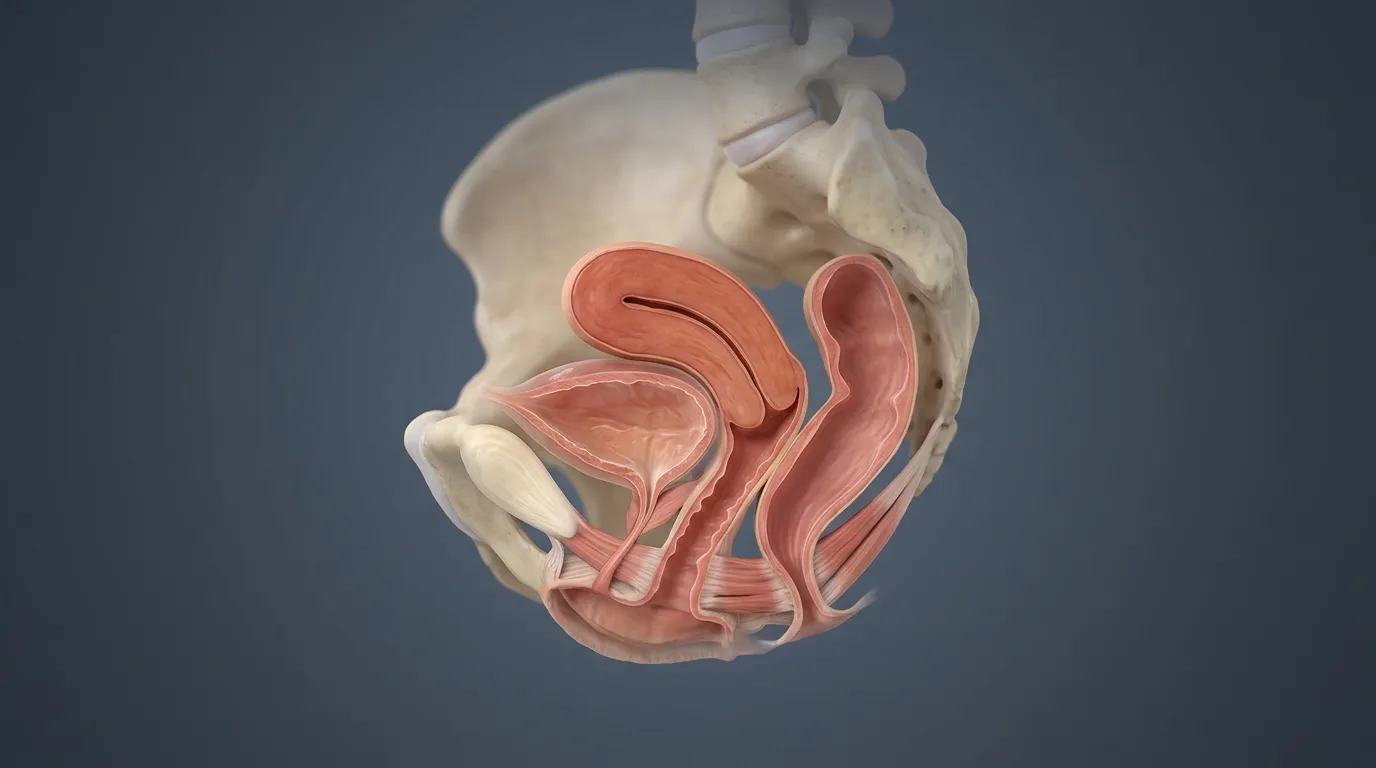
Appointments: +212 5 22 77 40 48, Centre d’Urologie Casablanca, Maârif.
Prolapse is common after childbirth or after the menopause, and you can talk about it without embarrassment. Your consultation is with one of our urologists, who explains the examination before doing it. It takes a few minutes and you are welcome to bring someone with you.
| Question | Answer |
|---|---|
| What can drop | The bladder (cystocele), the womb (uterine prolapse, also called hysterocele), the rectum (rectocele), often more than one at a time. |
| Most common sign | A feeling of a lump in the vagina. |
| First treatment | Pelvic floor muscle training with a physiotherapist, for at least 16 weeks (about four months), for a mild or moderate prolapse. [5] |
| Without an operation | A pessary, a soft ring placed in the vagina that holds the organs up. |
| Surgery offered | Sacrocolpopexy (promontofixation in French), most often with the robot, more rarely by laparoscopy (in both cases through small cuts in the abdomen, with a camera), in a private hospital, for a prolapse of the bladder, the womb or the rectum. |
01 / SYMPTOMS
A prolapse rarely hurts. Severe pain should be checked by a doctor the same day.
The rectum coming out through the anus (rectal prolapse) and haemorrhoids that come out are different conditions, treated by a digestive surgeon or a proctologist (a doctor for the rectum and anus).
02 / CAUSES
Childbirth, especially many or difficult births, the menopause and age are the main causes. The same factors make urine leaks more likely in Moroccan women, according to a survey of women in Casablanca published in 2003. [3] Anything that pushes down on the pelvic floor again and again makes the prolapse worse: constipation with straining, carrying heavy loads, a long-lasting cough, being overweight.
03 / ASSESSMENT
You are examined lying down, and asked to push or cough so the doctor can see which organ drops and how far. The doctor grades the prolapse on a scale from 1 (mild) to 4 (organ completely outside). This number alone does not decide whether to operate: what counts is how much it bothers you. An ultrasound scan often completes the examination. Before any operation, we carry out urodynamic tests at the practice. These tests measure how the bladder works and look for a leak that the prolapse may be masking. [4]
04 / TREATMENT
| Situation | What is most often offered |
|---|---|
| Mild prolapse, little bother | Monitoring and pelvic floor muscle training |
| Real bother, an operation not wanted or too risky | A pessary, to be cleaned or changed regularly |
| Bother that persists despite pelvic floor training, a prolapse of the bladder, the womb or the rectum, an active woman, wish to keep a sex life | Sacrocolpopexy |
| An older or frail woman, for whom a long anaesthetic is not advised | Repair through the vagina, a shorter operation |
At the clinic, we perform sacrocolpopexy for prolapse of all three compartments: the bladder, the womb and the rectum. A repair through the vagina is also done, in rarer cases: a very elderly woman, or a woman who cannot have a general anaesthetic, because it can be done under spinal anaesthesia (numbing of the lower body).
A small prolapse can stay stable for years, and it can improve. In an American study that followed 259 postmenopausal women, about one in five of the women whose prolapse reached the entrance of the vagina no longer had a prolapse at that level one year later. [2] A prolapse that bothers you rarely goes away on its own. For a mild or moderate prolapse that bothers you, pelvic floor muscle training supervised by a physiotherapist, for at least 16 weeks, is offered first. [5] This duration is the one that UK guidelines give for a prolapse. For leaks on effort, the same guideline asks for at least 3 months. [5] If it is not enough, we offer a pessary first to women who do not want an operation or cannot have one, and surgery to the others.
05 / BLADDER
The two problems are often linked. Leaking when you cough, laugh or lift (stress urinary incontinence) is treated with a mid-urethral sling, sometimes during the same operation, after discussing it: operating on both together increases the risk of side effects compared with repairing the prolapse alone. [6] The other way round, a large prolapse can hide a leak, which appears once the organs are lifted back into place. This is why urodynamic tests are done before the operation.
06 / WARNING SIGNS
In Morocco, call 141 (SAMU, the emergency medical service) or go to the nearest emergency department if:
If you are outside Morocco, call your local emergency number.
If you have had an operation: call the practice during opening hours, or the emergency number you were given when you left the clinic.
If the lump stays out, bleeds or becomes sore, see a doctor within the next few days.
07 / TRAVEL
If you live outside Morocco and plan a consultation or an operation in Casablanca:
08 / AT THE PRACTICE
At the practice, women with urine leaks and pelvic organ prolapse are seen by our urologists. The team includes Dr Alae Touzani, who holds a diploma from Paris in pelvic floor problems such as prolapse and urine leaks. [1] We carry out the examination and urodynamic tests on site, and we organise pelvic floor muscle training with a physiotherapist. When an operation is decided, it takes place in a private hospital, most often with the robot, more rarely by laparoscopy.
For the first consultation, bring your ultrasound reports, the list of your medicines and, if you have one, your bladder diary.
09 / QUESTIONS
No. It is a loosening of the tissues that support the organs. Any unusual bleeding from the vagina should still always be checked by a doctor.
It is better to avoid heavy loads and repeated straining, which increase the pressure on the pelvic floor and make the prolapse worse.
10 / APPOINTMENTS
Centre d’Urologie Casablanca, practice of Prof Adil Ouzzane and Dr Alae Touzani, 22 boulevard Yacoub El Mansour, Office 42, 5th floor, Maârif, 20250 Casablanca, Morocco.
Telephone: +212 5 22 77 40 48, Monday to Friday 9 am to 6 pm and Saturday 9 am to 1 pm (Morocco time). Request an appointment online.
11 / REFERENCES
Diploma “Pelvi-périnéologie et statique pelvienne”, Paris, on pelvic floor disorders and prolapse. In French.
View profileObstet Gynecol, 2007;109:848–54 (259 women followed for up to 4 years).
Read on PubMedSurvey carried out in Casablanca. Afr J Urol, 2003.
View referenceUrodynamic tests carried out at the practice. In French.
Visit the practice website2019, recommendations 1.7.5 (supervised pelvic floor muscle training for at least 16 weeks for symptomatic stage 1 or 2 prolapse), 1.4.4 (at least 3 months for stress or mixed urinary incontinence), 1.8.10, 1.8.11 and 1.8.16 (uterine and vault prolapse: sutured repairs, or sacrohysteropexy or sacrocolpopexy with mesh), 1.8.20 and 1.8.23 (anterior and posterior repair without mesh).
Read NICE recommendationsEAU Female LUTS, 2026 (combined prolapse and incontinence surgery: higher risk of side effects, to be discussed beforehand). There is currently no Moroccan guideline on prolapse or urinary incontinence in women.
Read the EAU guidelinesThis information is general and does not replace a consultation.
Appointments
The practice team can call you back about your request.
Do not include symptoms, a diagnosis, or other medical information in this form.
Would you rather call? +212 5 22 77 40 48