
Check how you pass urine
Measure the strength of your stream and the urine left in your bladder after you pass urine (residual volume).
Bladder stones · Casablanca
A bladder stone can cause frequent urges to urinate, blood in the urine or difficulty passing urine. Learn why stones form, how they are diagnosed and how they can be removed.
01 · Key points
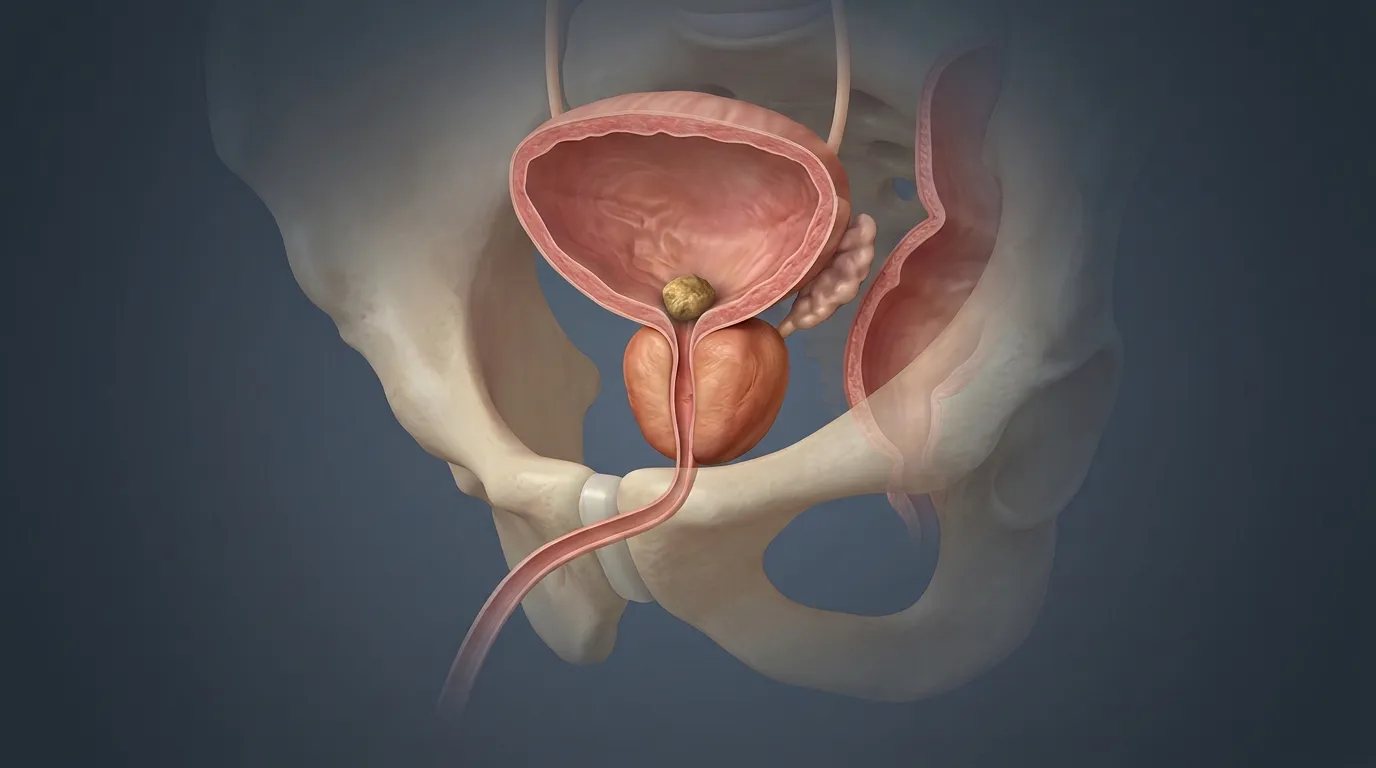
A bladder stone mostly affects men, usually because a blockage, most often the prostate, stops the bladder from emptying completely. Urine that stays in the bladder forms crystals that grow into a stone. It can cause frequent urges to urinate, blood or pain at the end of passing urine, or repeated urinary infections. It is usually treated through the urethra, with no cut: the stone is broken up and removed, and we also treat its cause.[1]
+212 5 22 77 40 48 · Centre d’Urologie Casablanca, Maârif.
02 · The procedure
The stone is removed through the urethra, the tube you pass urine through, with no cut at all. Compared with going through the skin, this treatment means a shorter stay, less pain and a faster recovery.[2]
In the United Kingdom, the NHS says the operation is done under a local or general anaesthetic, the hospital stay is 1 to 3 nights, and a urinary catheter may be left in until you can pass urine normally.[2] The type of anaesthetic, the length of your stay and when you can return to work are discussed at your consultation.
03 · Understanding the cause
Bladder stones account for about 5 in 100 urinary stones. They affect 4 to 10 men for every woman.[1]
In adults, the most frequent cause is a blockage at the outlet of the bladder.[1] In men, it is most often the prostate: an enlarged prostate, a growth that is not cancer, can stop the bladder from emptying fully. Less often, it is a narrowing of the urethra.[1]
Other situations can contribute: a urinary catheter left in for a long time, a bladder that empties poorly because of a nerve condition, or a bladder rebuilt after removal for cancer.[1] A stone that has come down from the kidney can also stay in the bladder and grow there.[1]
About 5 in 100 urinary stones are bladder stones.[1]
04 · The signs
The most frequent signs are:[1]
A stone can also make passing urine difficult or stop it altogether.[2] Finally, it may cause no sign at all and be found by chance.[1]
Call the practice the same day (+212 5 22 77 40 48) if you see blood in your urine without clots or passing urine becomes very painful.[2] Blood in the urine should always be checked by a doctor: it can have a cause other than a stone.[2] Outside Morocco, contact your local emergency number for urgent symptoms.
If you have had an operation: call the practice during opening hours, or the emergency number you were given when you left the clinic.
05 · Assessment
The first test is an ultrasound scan of the bladder.[1] If it shows nothing while symptoms persist, guidelines advise a cystoscopy (a thin camera passed through the urethra) or a CT scan.[1] Ultrasound and cystoscopy are available at the practice. Cystoscopy is done with anaesthetic gel.
Guidelines also advise looking for the reason the stone formed:[1]
Measure the strength of your stream and the urine left in your bladder after you pass urine (residual volume).
A urine test can look for an infection.
Once removed, the stone can be analysed to show what it is made of.
06 · Treatment
Under anaesthetic, the urologist passes an endoscope (a thin tube with a camera) through the urethra. The stone is broken up with a laser or a mechanical instrument, then the pieces are washed out or removed. This is called transurethral cystolithotripsy. European guidelines advise it first, as a strong recommendation.[1] Laser and mechanical instruments appear to give equivalent results, but the studies comparing them are few and of low quality.[1]
Like any operation through the urethra, it has risks: a urinary infection, blood in the urine for the first few days and, later, a narrowing of the urethra (stricture). Studies report a stricture in 3 to 20 patients per 100.[1] It can usually be treated with a short procedure through the urethra.
Through a small cut above the pubic bone when the urethra cannot be used.
Through an incision, for a very large stone.
Sent through the skin. They more often leave pieces in the bladder.
Medicine by mouth, only for uric acid stones and when guidelines support it with reservations.
07 · Related conditions
Yes. When the prostate is the cause, the stone and prostate can be treated in the same operation. The studies cited by European guidelines found no more serious complications, but temporary urine leakage and infections in the following weeks were a little more frequent.[1]
Prostate surgery is a transurethral resection (TURP) or laser enucleation, depending on prostate size: TURP for a prostate of 30 to 80 mL, and laser for a prostate of any size.[3]
Treating the stone without treating its cause can lead to another stone. That is why we always check the prostate and how well the bladder empties before suggesting an operation.
08 · Recovery
Burning when you pass urine, frequent urges and pinkish urine are usual. Drink regularly to keep your urine clear.
If you have had an operation: call the practice during opening hours, or the emergency number you were given when you left the clinic.
09 · Your care
Bring your ultrasound scans and urine tests to your consultation, and, if you have had one, the analysis of a previous stone.
10 · Contact
Centre d’Urologie Casablanca
22 boulevard Yacoub El Mansour, Office 42, 5th floor, Maârif, 20250 Casablanca, Morocco.
Telephone: +212 5 22 77 40 48, Monday to Friday 9 am to 6 pm and Saturday 9 am to 1 pm (Morocco time). Request an appointment online.
Emergency: 141 (SAMU) or the nearest hospital emergency department. Outside Morocco, call your local emergency number. If you have had an operation: call the practice during opening hours, or the emergency number you were given when you left the clinic.
11 · References
European Association of Urology, March 2026 update. Bladder stones chapter: frequency, symptoms, diagnosis and treatment.
Read the sourceNHS, reviewed 26 February 2026. Practical information about treatment and recovery after the procedure.
Read the sourceEuropean Association of Urology, March 2026 update. Recommendations on treating a bladder stone and enlarged prostate during the same operation.
Read the sourceThis information is general and does not replace a consultation.
Appointments
The practice team can call you back about your request.
Do not include symptoms, a diagnosis, or other medical information in this form.
Would you rather call? +212 5 22 77 40 48