
Two small glands next to the prostate.
Source [1]Prostate cancer · Casablanca
Radical prostatectomy for prostate cancer
A radical prostatectomy removes the prostate to treat some localised cancers. Learn who may benefit, how the operation is prepared, and what recovery can involve.
01 · The essentials
Key points
A radical prostatectomy removes the whole prostate. “Radical” means complete. It is a reference treatment for some localised cancers when your general health and the cancer allow it. It can be done with a surgical robot, by laparoscopy (keyhole surgery without the robot), or as open surgery. Its possible side effects are urine leakage (incontinence), which can occur but is most often temporary, and erection problems (erectile dysfunction), which depend on age, erections before the operation, the stage of the disease and whether the nerves can be spared.
Appointments: +212 5 22 77 40 48 · Centre d’Urologie Casablanca, Maârif district.
02 · Quick guide
At a glance
The decision is made case by case, taking life expectancy, general health and the cancer’s risk level into account.
Source [1]The options are discussed with your surgeon in light of your situation.
Source [1]After the biopsy; usually 12 weeks after a TURP.
Source [1]In our series of 132 men, the continence rate reported by the authors was 83 in 100 at 6 weeks.
Source [2]03 · The procedure
What does the operation involve?
The surgeon removes the prostate with its capsule (outer layer) and the seminal vesicles, then joins the bladder to the urethra (the tube urine passes through) with a watertight line of stitches.[1] The aim is to remove all the cancer while keeping, as far as possible, the muscles and nerves that hold urine in and allow erections.[1]
Surgical aim
Remove the prostate and reconnect the bladder to the urethra, preserving nearby structures when the cancer and your health allow it.
04 · Choosing treatment
Who is it for?
The 2023 Moroccan national guideline makes surgery the reference treatment for localised prostate cancer in a man whose health suggests more than ten years of life ahead. In older trials, surgery extended survival compared with simple observation and delayed treatment.[1]
The ProtecT trial in the United Kingdom followed men for 15 years whose often slow-growing cancer had been found by a PSA test.[4] The risk of dying from the cancer remained low, at about 3 in 100, whether men had surgery, radiotherapy or close monitoring (active monitoring in the trial). The cancer spread to other organs in about 9 in 100 men in the monitoring group, against 5 in 100 after surgery or radiotherapy.[4] This is why the cancer's risk level guides the choice.
Surgery may be a good choice
The choice depends on life expectancy, general health and the features of the cancer. It is made case by case.
Active surveillance may suit
Often a better fit for a low-risk cancer that is growing slowly.[1]
Combined treatment may be offered
Surgery can be part of a combined plan, followed for example by radiotherapy.[1]
The risk level is read from the prostate biopsy report and MRI. Our prostate cancer page explains this and compares surgery with radiotherapy.
05 · Surgical approach
Robot, laparoscopy or open surgery?
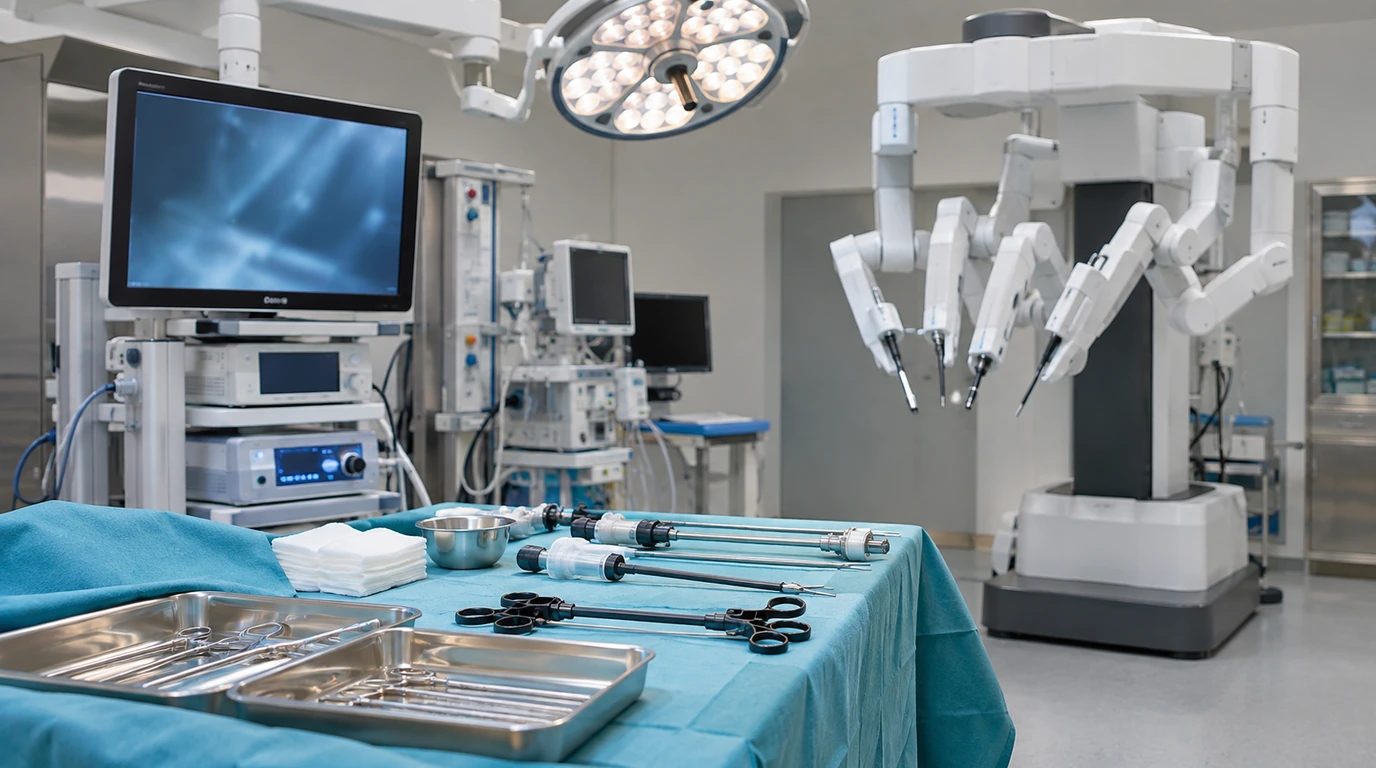
The robot is perfectly suited to prostate surgery: the prostate is a deep organ, surrounded by complex structures, and the operation requires great precision. The robot gives the surgeon a three-dimensional view and wristed instruments, for precise movements. It does not work on its own: it is what the robot makes possible, combined with the experience of the surgeon and the team, that gives good results. The two small-incision approaches, robot and laparoscopy, cause less bleeding and a shorter hospital stay than open surgery.[1] The studies that showed no major difference between robotic, laparoscopic and open surgery are old: they compared surgeons who were starting with the robot to surgeons with years of practice in open or laparoscopic surgery.
We perform robot-assisted radical prostatectomy at the Centre d’urologie Oasis in Casablanca, a hospital in the Akdital group, a Moroccan private hospital network.[2] Our robotic surgery page describes the robot and how it works.
Robot-assisted
The surgeon controls articulated instruments from a console.
Laparoscopy
Small-incision surgery using instruments controlled directly by the surgeon.
Open surgery
The traditional approach, through an incision in the abdomen.
06 · Erectile function
Can erections be preserved?
Nerve sparing
Erections depend on two thin bundles of nerves and blood vessels lying against the prostate, the neurovascular bundles. Keeping them during surgery makes it possible to keep erectile function, but not always.[1]
The decision to spare the neurovascular bundles is made for each side separately. It depends on the cancer stage, grade and aggressiveness, and its location on MRI and biopsy. Sparing the nerves must not compromise the treatment of the cancer.[1] Your age and the quality of your erections before surgery also matter.[1]
07 · Staging
Should the lymph nodes be removed?
The lymph nodes along the blood vessels of the pelvis can be removed during the operation. This is a lymph node dissection. It is advised when the calculated risk that these nodes contain cancer is above 5 in 100.[1] It shows how far the cancer has spread more accurately than scans, but does not on its own improve survival. It slightly increases the risk of complications, including a pocket of lymph fluid in the pelvis, called a lymphocele.[1]
08 · Preparation
Before the operation
The operation may take place a few days to a few weeks after the biopsy; after a TURP (transurethral resection of the prostate), it usually takes place 12 weeks later.[1]
Blood-thinning medicines are stopped or replaced with the advice of the anaesthetist and cardiologist.[1]
Hormone treatment or chemotherapy before the operation is not recommended.[1]
09 · Hospital stay
The operation and hospital stay
The operation is done under general anaesthetic. With the robot, the surgeon works through small incisions in the abdomen. In our series, half of the operations lasted less than 2 hours 35 minutes, and none had to be finished as open surgery.[2]
Most patients leave hospital the day after the operation. You go home with a urinary catheter, a thin tube that drains the bladder. It stays for a few days while the join between the bladder and urethra heals, and is removed at a consultation.
The approach and duration depend on your case and the procedure.
You leave with a urinary catheter, removed a few days later at a consultation.
10 · Recovery
After the operation: continence and erections
Leakage can happen after the catheter comes out, then lessen. In our series of 132 men operated on in Casablanca between December 2024 and October 2025, the continence rate reported by the authors was 30 in 100 as soon as the catheter was removed, 83 in 100 at six weeks and 92 in 100 at three months.[2] Pelvic floor exercises, which train the muscles that hold urine in, help men regain control.[3]
Erections come back more slowly. How erections come back depends on your age, on the stage of the disease, which affects whether the erection nerves can be spared on one side or both, and on the quality of your erections before the operation. We practise nerve sparing, decided case by case. Recovery usually continues for many months, and treatments exist to help it.[3]
The authors call these results preliminary, because they come from a single centre and a single surgeon, with short follow-up (3 months) and no comparison group.[2] For the longer term, the ProtecT trial in the United Kingdom gives other reference points: between 7 and 12 years after surgery, 18 to 24 in 100 men wore pads for leakage.[7] Techniques have changed since then. After the operation there is no more ejaculation. Orgasm is still possible, but without semen, because the prostate and seminal vesicles have been removed.[3] Our continence and erections after prostatectomy page explains pelvic floor exercises, treatments and follow-up.
11 · Safety
Side effects, risks and warning signs
Possible effects include leakage and erection problems described above, and loss of ejaculation. In our series of 132 men, complications occurred in 6 men in 100, none serious: none needed a new operation under general anaesthetic, and no robot failure forced a change of technique.[2] Injury to a blood vessel, the rectum or a ureter (the tube that carries urine from a kidney to the bladder) during the operation is rare.[1]
In Morocco, call 141 (SAMU) or go to the nearest emergency department after the operation if:
- you have a fever (38 °C or more) or shivering
- you cannot pass urine, or the catheter stops draining
- you are bleeding heavily, with clots in your urine
- a calf becomes painful or swollen, or you have chest pain or shortness of breath (possible signs of a blood clot), including during or after a flight
- you have abdominal pain that gets worse, or you are vomiting.
If you have had an operation: call the practice during opening hours, or the emergency number you were given when you left the clinic. If you are outside Morocco, call your local emergency number.
12 · Travel planning
Coming from abroad
If you live outside Morocco and plan your operation in Casablanca:
Before you travel, send or bring the documents listed under “What should I bring to the consultation before the operation?” Ask on the phone how to send them, so your case can be prepared before you arrive. You can also write to urocasa@gmail.com.
Plan your stay to cover the consultation before surgery, the operation, the hospital stay and the visit at which the catheter is removed. At the consultation, ask how long to stay in Casablanca before flying home. After an operation, plan to stay about a week in Casablanca on average, to be confirmed at the consultation.
Before you leave, ask for your operation report and how you will receive the laboratory result on the removed prostate if you have already flown home.
The PSA tests and checks of bladder control that follow can be shared with a urologist where you live. Agree with us how your results reach us.
13 · Your care
At the practice
At the Centre d’Urologie Casablanca, we see you before the operation to go through the MRI and biopsy with you, and to decide whether surgery is the right choice. The operation takes place at the Centre d’urologie Oasis in Casablanca. We then do the follow-up at the practice: catheter removal, PSA tests, continence and erections.
Prof Ouzzane’s publications include work on positive surgical margins after minimally invasive radical prostatectomy[5] and on the place of surgery in high-risk cancers.[6] The series of 132 robotic prostatectomies performed in Casablanca was published in 2026.[2]
Prof Ouzzane’s career and research14 · Your questions
Frequently asked questions
How is follow-up done after the operation?
The PSA should become undetectable within 6 weeks of the operation. It is then measured regularly. If it rises above 0.2 ng/mL on two tests in a row, this is called a biochemical recurrence, and radiotherapy may be offered.[1]
What should I bring to the consultation before the operation?
The biopsy report, your MRI CD and report, your latest PSA results, any other scans (CT or bone scan) if done, and a list of your medicines, especially blood thinners.
15 · Contact
Book an appointment
Centre d’Urologie Casablanca
22 boulevard Yacoub El Mansour, Office 42, 5th floor, Maârif, 20250 Casablanca, Morocco.
Phone: +212 5 22 77 40 48, Monday to Friday 9 am to 6 pm and Saturday 9 am to 1 pm. Request an appointment online.
Emergency in Morocco: 141 (SAMU) or the nearest hospital emergency department. If you have had an operation: call the practice during opening hours, or the emergency number you were given when you left the clinic.
Consultations are in French, Arabic and English.
16 · References
Sources
- 01
Moroccan national guideline: Cancer of the prostate
ANAM, Ministry of Health and Social Protection, National Council of the Order of Physicians and Moroccan Society of Medical Sciences, 2023. Sections on radical prostatectomy, preparation, nerve sparing, lymph node dissection, complications and biochemical recurrence.
View source - 02
Robotic-assisted radical prostatectomy using the Toumai system: initial single-centre experience in Morocco
Et-Touzani R et al. (senior author: Ouzzane A). Journal of Robotic Surgery, 2026.
View source - 03
EAU Guidelines on Prostate Cancer
European Association of Urology, edition consulted November 2026.
View source - 04
Fifteen-year outcomes after monitoring, surgery, or radiotherapy for prostate cancer
Hamdy FC et al. (ProtecT trial). New England Journal of Medicine, 2023.
View source - 05
Positive surgical margins after minimally invasive radical prostatectomy in patients with pT2 and pT3a disease could be considered pathological upstaging
Ouzzane A et al. BJU International, 2014.
View source - 06
Radical prostatectomy for locally advanced and high-risk prostate cancer: a systematic review of the literature
Prof Ouzzane, senior author. Progrès en Urologie, 2018.
View source - 07
Patient-Reported Outcomes 12 Years after Localized Prostate Cancer Treatment
Donovan JL et al. (ProtecT trial). NEJM Evidence, 2023.
View source
This information is general and does not replace a consultation.
Appointments
Request an appointment about radical prostatectomy
The practice team can call you back about your request.
Do not include symptoms, a diagnosis, or other medical information in this form.
Would you rather call? +212 5 22 77 40 48