
How long is the hospital stay?
Often one night, the time it takes to remove the catheter and check that you pass urine well.
Prostate surgery · Casablanca
When a small prostate, under 30 mL, squeezes the outlet of the bladder, a transurethral incision of the prostate (TUIP), also called bladder neck incision, reopens the way for urine with two cuts. The urologist makes them through the urethra, with no scar and without removing any tissue. Compared with a resection (TURP), it relieves symptoms as well and more often preserves ejaculation, but it has to be repeated more often.
Book an appointment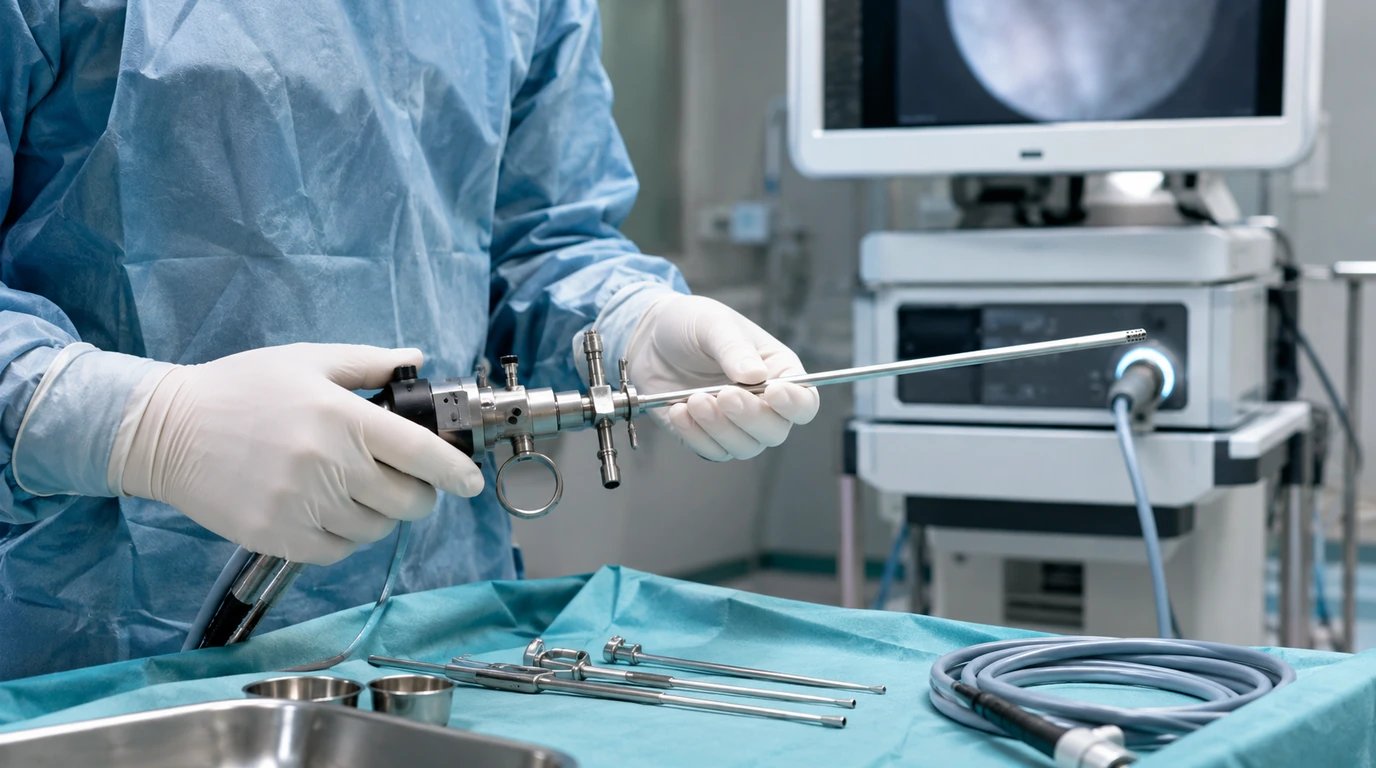
01 / AT A GLANCE
| Question | Short answer |
|---|---|
| Who is it for? | A prostate under 30 mL, with no middle lobe, that still bothers you despite medicines [1] |
| Result | As effective as TURP on urinary symptoms for these small prostates [1] |
| Ejaculation | Semen goes back into the bladder (retrograde ejaculation) much less often than after a TURP [1] |
| Bleeding | Negligible risk of needing a transfusion [1] |
| Another operation | About 18 men in 100 after an incision, 7 in 100 after a TURP, in an analysis of six trials [1] |
Appointments: +212 5 22 77 40 48 · Centre d’Urologie Casablanca, Maârif.
02 / WHO IT SUITS
The French name of the operation, incision cervico-prostatique, refers to the bladder neck and the prostate. The bladder neck is where the bladder narrows to join the urethra, just above the prostate. In some men, the bladder neck and a small prostate form a ring that is too tight. Urine passes poorly, even though the prostate is not very large.
European guidelines recommend the incision, with a strong recommendation, when the prostate measures less than 30 mL on ultrasound and has no middle lobe [1]. The middle lobe is a part of the prostate that bulges into the bladder like a tongue: the incision does not treat it. Above 30 mL, or with a middle lobe, a TURP or a laser enucleation is offered. Our page on enlarged prostate (benign prostatic hyperplasia, BPH) explains this choice and how to prepare for the operation.
03 / COMPARISON
For a prostate under 30 mL, trials show the same improvement in urinary symptoms as with a TURP. The strength of the stream improves a little less [1].
Its side effects are milder. After a TURP, semen often goes back into the bladder instead of coming out (retrograde ejaculation): the pleasure remains, but having a child naturally becomes difficult. After an incision, this happens much less often. The risk of a transfusion is negligible, and no case of TUR syndrome, a problem caused by the rinsing fluid being absorbed, has been reported in the studies [1].
The trade-off is that the result lasts less often. In an analysis of six trials, about 18 men in 100 needed another operation after an incision, against 7 in 100 after a TURP [1]. If keeping your ejaculation matters most to you, the incision often suits you better. If you want to lower the risk of needing another operation, choose TURP instead.
04 / THE PROCEDURE
You are asleep (general anaesthetic), or only the lower half of your body is numbed (spinal anaesthetic). The urologist passes an endoscope, a thin tube with a camera, through the urethra. They make a cut on each side, from the bladder neck down to the prostate. The edges spread apart and the passage opens.
According to European guidelines, the cut can be made with an electric instrument or with a Holmium laser. In a trial comparing the two in prostates of 30 mL or less, they were equally effective. The electric instrument was quicker and affected ejaculation less [1].
A urinary catheter is put in at the end of the operation. It is removed once the urine is clear, usually the next day.
05 / RECOVERY
Burning when you pass urine and pink urine are normal in the first few days. Drink regularly. For two to three weeks, avoid carrying heavy loads and long rides on a bicycle or motorbike. A follow-up consultation checks that your stream has improved.
A urinary infection is possible, as after any procedure through the urethra. Later, the trouble can come back, especially if the prostate keeps growing: a TURP or a laser enucleation is then offered.
06 / WHEN TO GET HELP
In Morocco, call 141 (SAMU, the emergency medical service) or go to the nearest emergency department if:
If you are outside Morocco, call your local emergency number.
If you have had an operation: call the practice during opening hours, or the emergency number you were given when you left the clinic.
07 / AT THE PRACTICE
At our practice in Maârif, we carry out the assessment before the operation: consultation, urine flow test (which measures the strength of your stream), ultrasound of the prostate to measure its volume and check there is no middle lobe, and, if needed, a urodynamic test (which measures pressure in the bladder while it fills and empties). The operation takes place at the Centre d’urologie Oasis in Casablanca (Akdital group, a Moroccan private hospital network).
08 / INTERNATIONAL PATIENTS
If you live outside Morocco and plan your TUIP in Casablanca:
09 / QUESTIONS
Often one night, the time it takes to remove the catheter and check that you pass urine well.
Office work can usually start again after about a week. For physical work, allow two to three weeks, the time during which strain should be avoided.
Some studies have tested it up to 60 mL, but European guidelines keep it for prostates under 30 mL with no middle lobe [1]. Above that, a TURP or a laser enucleation gives a longer-lasting result.
10 / APPOINTMENTS
Centre d’Urologie Casablanca, practice of Prof Adil Ouzzane and Dr Alae Touzani, 22 boulevard Yacoub El Mansour, Office 42, 5th floor, Maârif, 20250 Casablanca, Morocco.
Telephone: +212 5 22 77 40 48, Monday to Friday 9 am to 6 pm and Saturday 9 am to 1 pm (Morocco time). Request an appointment online.
11 / REFERENCES
March 2026 update, section 5.3.1.d (transurethral incision of the prostate: indication under 30 mL with no middle lobe, efficacy, ejaculation, transfusion, no TUR syndrome reported, reoperation 18.4% against 7.2%, trial of electric instrument against Holmium laser). There is currently no Moroccan guideline on enlarged prostate.
View EAU guidelinesThis information is general and does not replace a consultation.
Appointments
The practice team can call you back about your request.
Do not include symptoms, a diagnosis, or other medical information in this form.
Would you rather call? +212 5 22 77 40 48